 How-to
Spinal Decompression for Manual Laborers: Relief Without Surgery
Table of Contents
- What Spinal Decompression Is and How It Works for Manual Laborers
- Spinal Decompression for Herniated Disc and Nerve Pressure
- Spinal Decompression Treatment Duration and What to Expect
- Spinal Decompression Risks and Side Effects
- Manual Labor Back Pain Prevention and Workplace Safety
- When to Seek Professional Care and Red Flags
- Nonsurgical Decompression vs. Surgery: Why Conservative Treatment Matters
- Frequently Asked Questions
Last Updated: October 18, 2026
What Spinal Decompression Is and How It Works for Manual Laborers
Spinal decompression for manual laborers is a nonsurgical treatment that gently stretches the spine to reduce pressure on discs and nerves.
Manual laborers face unique spinal stress that makes spinal decompression for manual laborers an important treatment option: heavy lifting, repetitive bending, and awkward postures compress discs over time, and construction workers, warehouse staff, and trade professionals can't simply adjust their seating.
At Sarasota Disc Center, we work with manual laborers who've tried other approaches yet the pain persists. Decompression targets the root cause: pressure crushing your discs and pinching nerves.
Manual decompression techniques
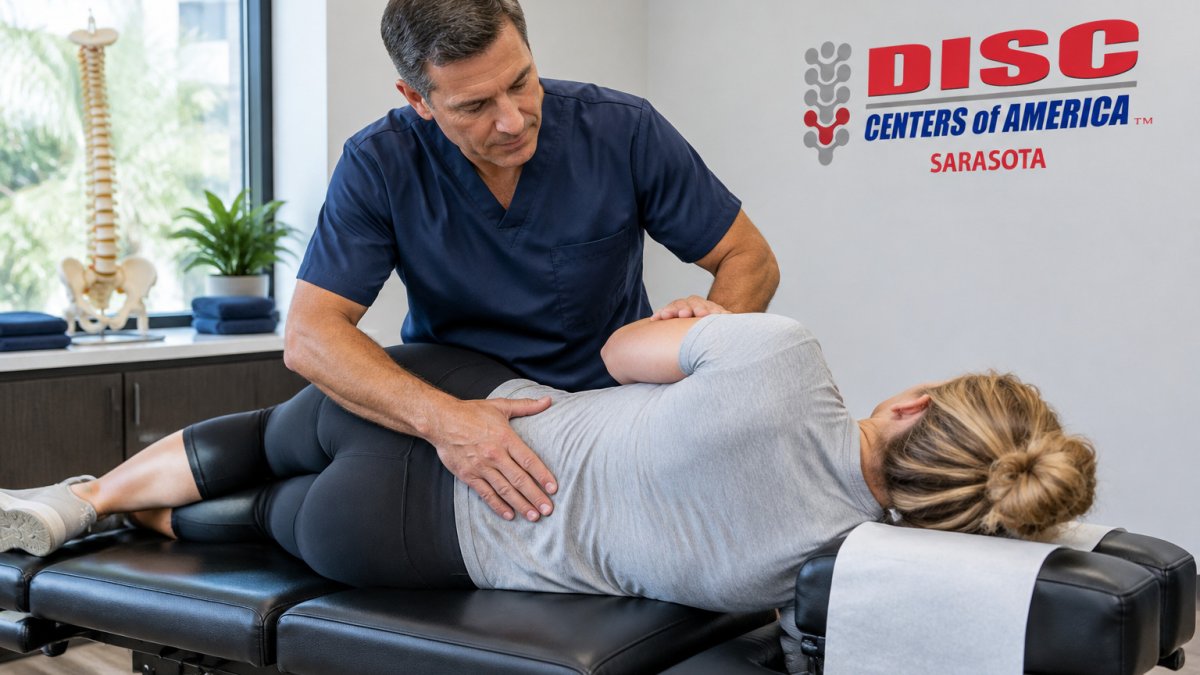
Manual decompression works best for mild to moderate disc issues. It's less intensive than motorized traction but depends heavily on the therapist's skill and your body's response.
Motorized traction and table-based decompression
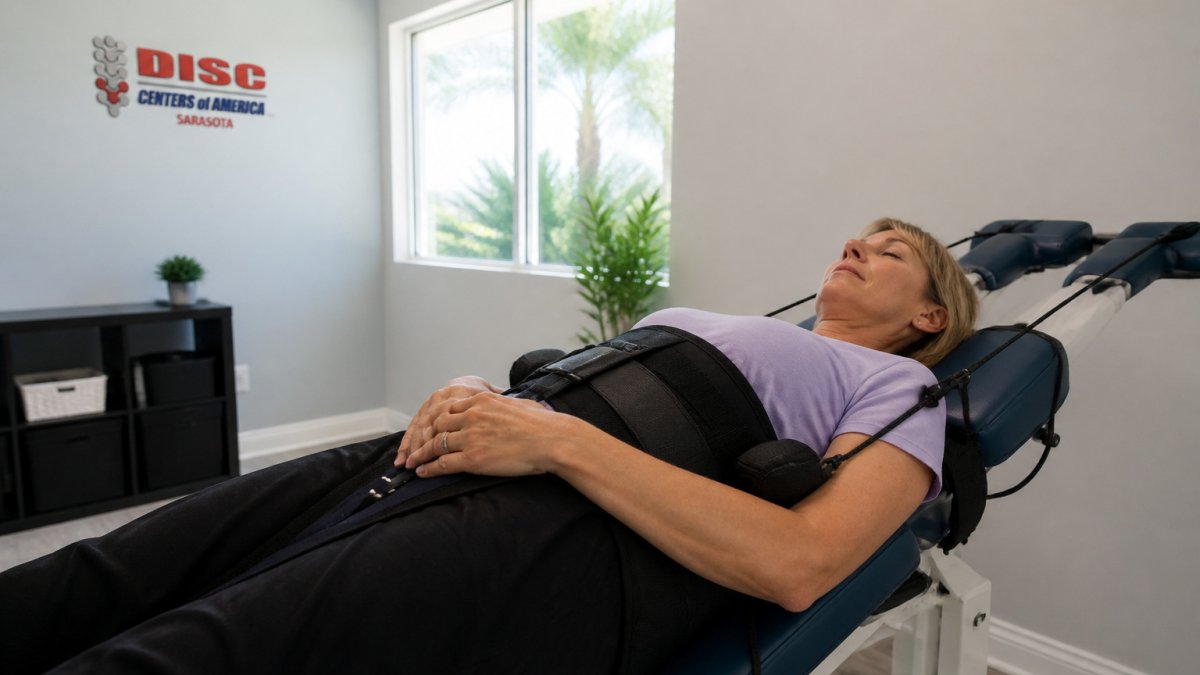
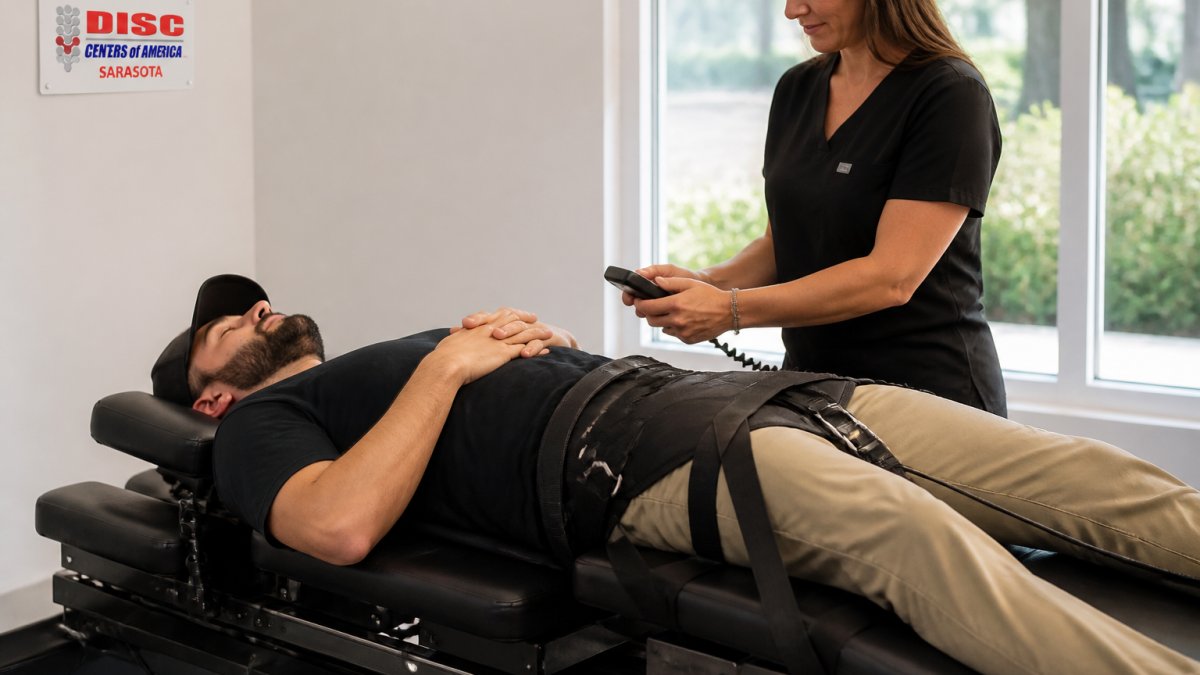
Motorized decompression uses specialized equipment to apply consistent, measurable force. You lie on a traction table while a computer-controlled system gradually stretches your spine over 20-30 minutes.
The table pulls your vertebrae apart with precise tension. This negative pressure inside the disc encourages bulging or herniated material to retract. Nerves get room to breathe.
Motorized traction offers advantages for manual laborers:
- Consistency: The machine delivers the same force every session, removing guesswork
- Precision: Your provider adjusts traction force based on your condition and progress
- Repeatability: You get multiple sessions per week without therapist fatigue affecting quality
Motorized decompression can offer advantages for manual laborers because the equipment does the work while you relax.
Spinal Decompression for Herniated Disc and Nerve Pressure
How disc herniation causes back and leg pain
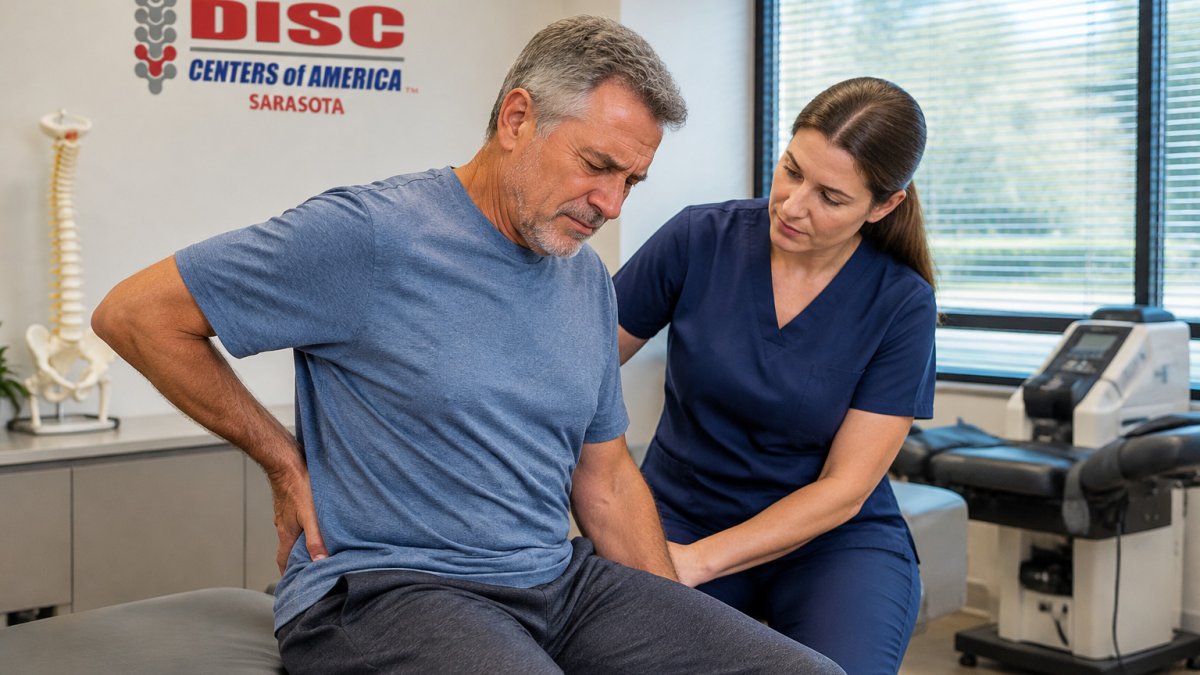
A herniated disc occurs when the soft inner core pushes through the tough outer shell, pressing on nearby nerves and causing sharp, burning pain that radiates down your leg (sciatica), arm, or both.
Manual labor accelerates disc degeneration. Lifting with a curved spine, twisting under load, and repetitive compression wear down disc material. Over years, the outer shell cracks. The inner gel leaks out.
Pain from a herniated disc feels different than muscle strain:
- Sharp, shooting pain down one leg or arm
- Numbness or tingling in your foot or hand
- Weakness in specific muscle groups
Many manual laborers ignore early warning signs, a twinge here, stiffness there, until a heavy lift or sudden twist ruptures the disc and pain becomes unbearable.
How decompression reduces nerve pressure
Spinal decompression creates negative pressure inside the damaged disc. When your spine stretches, the space between vertebrae expands, pulling the herniated material back toward its center and away from the pinched nerve.
As pressure decreases, several things happen:
- Nerve inflammation subsides
- Blood flow increases to the damaged disc
- Pain signals stop firing
- Mobility returns gradually
The process isn't instant, discs heal slowly, but with consistent sessions, people may notice improvement. Nerves may quiet down, bending may become less painful, and walking may become easier.
Spinal Decompression Treatment Duration and What to Expect
Typical treatment timelines for manual laborers
Treatment duration depends on severity and symptom history. Acute injuries typically respond faster than chronic conditions.
A typical treatment plan looks like this:
- Weeks 1-2: Initial assessment and baseline imaging. You'll have 2-3 sessions per week to establish treatment tolerance
- Weeks 3-6: Increased frequency, usually 3-4 sessions weekly. Patients may notice pain reduction
- Weeks 7-12: Continued sessions as pain improves. Frequency may decrease to 2-3 times per week as your disc heals
- Weeks 13+: Maintenance sessions (1-2 per week) to prevent recurrence
Total treatment duration varies. Some patients may see results in a shorter timeframe, while others may require a longer course.
Manual laborers often ask: "Can I work during treatment?" Usually yes, with modifications, heavy lifting and repetitive bending must stop or be severely limited, while lighter duty work is fine.
Returning to work during and after treatment
Returning to full manual labor too quickly causes reinjury. Your disc is healing, not healed. Premature heavy lifting can rupture it again.
A practical return-to-work progression:
- Weeks 1-4: Light duty only. Desk work, administrative tasks, or very light physical work (no lifting over 10 pounds)
- Weeks 5-8: Modified duty. You can resume some physical tasks but avoid heavy lifting and repetitive bending. Use proper body mechanics for everything
- Weeks 9-12: Gradual return to normal duties. Start with 50% of your normal physical demands, increase by 25% every 2 weeks
- Week 13+: Full duty, assuming pain-free. Continue maintenance decompression to prevent recurrence
This timeline isn't rigid, your provider will adjust based on progress. Listen to your body; pushing too hard wastes the progress you've made.
Spinal Decompression Risks and Side Effects
Spinal decompression is generally safe, though not risk-free. Most side effects are mild and temporary.
Common side effects include:
- Muscle soreness: Similar to starting a new exercise program. Usually subsides after 2-3 sessions
- Temporary pain increase: Some patients experience a brief flare before improvement. This typically resolves within days
- Tingling or numbness: Occasionally occurs as nerves "wake up" and inflammation decreases. Usually temporary
- Headache: Rare, but can occur from muscle tension changes during treatment
Serious complications are uncommon but possible. Decompression isn't appropriate for everyone. Contraindications include:
- Severe osteoporosis (bone too fragile for traction)
- Spinal fusion surgery (altered spine mechanics)
- Cauda equina syndrome (emergency condition requiring immediate surgery)
- Severe spinal stenosis in multiple levels
Your provider screens for these conditions before treatment. Be honest about your medical history, mention any previous spine surgery or serious health conditions upfront. Sarasota Disc Center specializes in non-surgical spinal decompression and offers conservative treatment options for patients who have failed other therapies, including post-surgical patients still experiencing chronic pain.
Manual Labor Back Pain Prevention and Workplace Safety
Prevention is always easier than treatment. Once you've had a herniated disc, you're at higher risk for recurrence. Smart workplace habits protect your spine.
Lifting technique and body mechanics
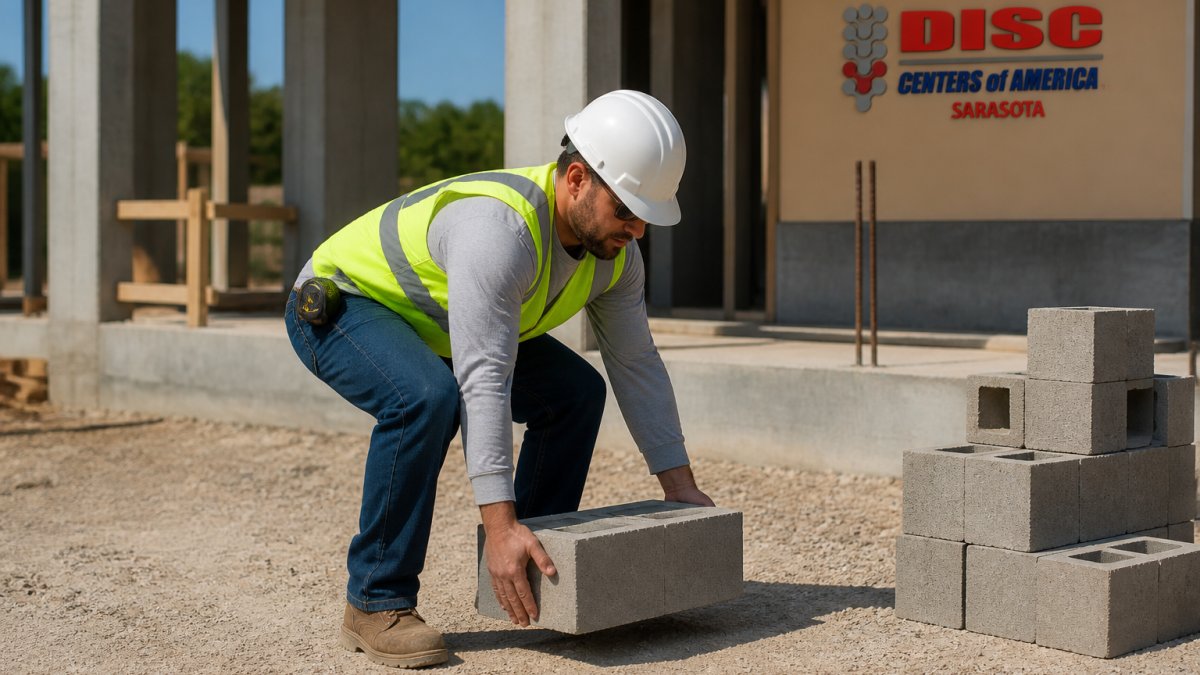
How you lift matters more than what you lift. Poor technique compresses discs. Good technique distributes load safely.
CALL TODAY TO SCHEDULE YOUR FREE CONSULTATION →
The right way to lift:
- Assess the load: Can you carry it alone? Do you need help? Is it awkwardly shaped?
- Get close: Stand directly next to the object. Don't reach out. Reaching increases strain
- Bend at the knees: Squat down, keeping your back straight. Never bend at the waist
- Engage your core: Tighten your abdominal muscles before lifting
- Lift smoothly: Use your legs, not your back. Keep the load close to your body
- Avoid twisting: Pivot with your feet. Never twist your spine while holding weight
- Set down safely: Reverse the lifting process. Bend at the knees, keep your back straight
These steps take seconds and feel awkward at first, but become automatic with practice. Every lift done right is one less injury risk.
Common mistakes manual laborers make:
- Lifting with rounded spine (most common cause of disc herniation)
- Reaching far from body (multiplies force on discs)
- Twisting while holding weight (shears disc material)
- Rushing (no time for proper technique)
Workplace ergonomics and task modification
Your workspace setup affects your spine, poor ergonomics cause cumulative damage over months and years.
Key ergonomic adjustments:
- Work at waist height: Reaching up or bending down repeatedly strains your spine. Adjust your work surface to waist level when possible
- Avoid repetitive bending: If your job requires frequent bending, take breaks every 30 minutes. Stand, walk, stretch
- Use tools properly: A tool that's too short forces you to bend. A tool that's too long strains your shoulders. Choose equipment that fits your body
- Rotate tasks: Doing the same motion all day fatigues specific muscles. Switch to different tasks every 1-2 hours
Talk to your employer about modifications. Many companies will adjust tasks to prevent injury, it's cheaper for them than workers' compensation claims.
Stretch routines and mobility maintenance
Daily stretching keeps your spine mobile and muscles flexible. Tight muscles pull your spine out of alignment. Stiff discs are more prone to herniation.
Essential stretches for manual laborers:
- Forward bend: Stand with feet hip-width apart. Slowly bend forward, letting your arms hang. Hold 30 seconds. This stretches your entire posterior chain
- Knee-to-chest: Lying on your back, pull one knee toward your chest. Hold 30 seconds per side. Relieves lower back tension
- Cat-cow stretch: On hands and knees, arch your back (cow), then round it (cat). Repeat 10 times. Mobilizes your entire spine
- Spinal twist: Lying on your back, pull one knee across your body toward the opposite shoulder. Hold 30 seconds per side. Opens your mid-back
Do these stretches daily, especially after work. Morning stretches prepare your spine for the day. Evening stretches prevent overnight stiffness.
Mobility maintenance also includes:
- Walking 20-30 minutes most days (promotes disc hydration and muscle tone)
- Swimming or water aerobics (low-impact movement)
- Yoga (builds flexibility and core strength)
- Pilates (strengthens deep spinal stabilizers)
When to Seek Professional Care and Red Flags
Not all back pain requires professional treatment, muscle strains often resolve with rest and stretching, but certain symptoms demand immediate evaluation.
Seek professional care if you have:
- Pain lasting more than 2 weeks despite rest
- Sharp, shooting pain down your leg or arm (suggests nerve involvement)
- Numbness or tingling in your leg or foot
- Weakness in your legs or difficulty controlling bowel/bladder
Red flags requiring emergency care:
- Sudden loss of bowel or bladder control
- Severe leg weakness or paralysis
- Fever with back pain (suggests infection)
- Progressive numbness or weakness worsening over hours
These symptoms suggest serious conditions like cauda equina syndrome, infection, or fracture. Don't wait, get emergency evaluation.
At Sarasota Disc Center, we evaluate every new patient thoroughly. If decompression isn't appropriate for your condition, we'll tell you. Our goal is your health.
Nonsurgical Decompression vs. Surgery: Why Conservative Treatment Matters
Spinal surgery carries real risks:
- Infection
- Nerve damage during surgery
- Failed fusion (bones don't fuse properly)
- Adjacent segment degeneration (spine above or below the fusion degenerates faster)
Surgery also costs significantly more than conservative care.
Nonsurgical decompression offers advantages:
- No surgical risks
- Faster recovery
- Lower cost
- Reversible (you can stop anytime)
Conservative treatment is often recommended first.
Many people fear that trying decompression first will somehow make surgery "harder" later.
The key: give conservative treatment adequate time.
Manual laborers face unique spinal demands. Your job requires physical strength and endurance.
At Sarasota Disc Center, we specialize in nonsurgical spinal decompression for patients like you.
Frequently Asked Questions
Can spinal decompression help back pain from heavy lifting?
Yes. Spinal decompression works by gently separating spinal vertebrae to reduce pressure on discs and nerves, pressure that heavy lifting often creates or worsens. For manual laborers, this treatment targets the root cause of work-related back pain. However, decompression is most effective when combined with proper lifting technique and workplace modifications to prevent re-injury after treatment ends.
How long does spinal decompression treatment take?
Treatment duration varies based on your condition's severity and how your body responds. Treatment duration and session frequency vary based on your individual needs. Your provider will create a custom schedule. Many manual laborers can continue working during treatment, though heavy lifting may need to be limited initially.
What are the downsides of spinal decompression therapy?
Spinal decompression is generally well-tolerated, but some patients experience temporary muscle soreness, mild discomfort during traction, or increased pain if the treatment isn't right for their condition. It's not suitable for everyone, and your provider will determine if you are a good candidate. A consultation with a qualified professional will determine if you're a good candidate and discuss any individual risks.
Can I do spinal decompression myself at home?
Self-care stretches and mobility work can reduce pain and prevent injury, but clinical spinal decompression requires specialized motorized traction tables. Home stretches complement professional treatment but don't replace it. A clinician will assess your specific condition and design a treatment plan tailored to your needs.