 listicle
Does Spinal Decompression Really Work? Evidence & Outcomes
Table of Contents
- What Spinal Decompression Therapy Actually Does
- Non-Surgical Spinal Decompression Success Rate: What the Research Shows
- How Long Does Spinal Decompression Take to Work?
- Who Is a Candidate for Spinal Decompression?
- Real Patient Outcomes and Limitations
- Spinal Decompression vs. Other Conservative Treatments
- Cost, Timeline, and What to Expect
- Conclusion: Is Spinal Decompression Right for You?
- Frequently Asked Questions
Last Updated: September 30, 2026
What Spinal Decompression Therapy Actually Does
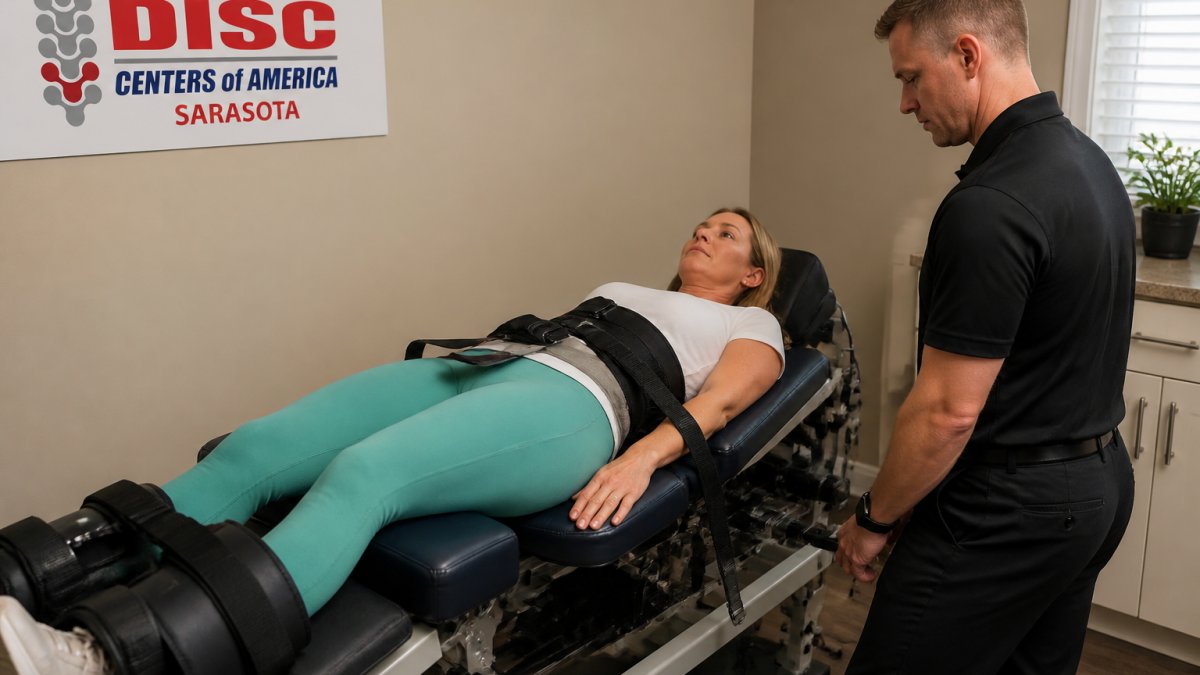
Spinal decompression therapy is a non-surgical treatment using computer-controlled mechanical traction to reduce pressure on compressed nerves and damaged discs. It gently stretches the spine, creating negative intradiscal pressure that retracts herniated or bulging disc material, relieving nerve compression and associated pain.
Unlike standard traction, spinal decompression uses computer-controlled cycles of distraction and relaxation that encourage disc hydration and nutrient exchange while reducing mechanical stress on nerves.
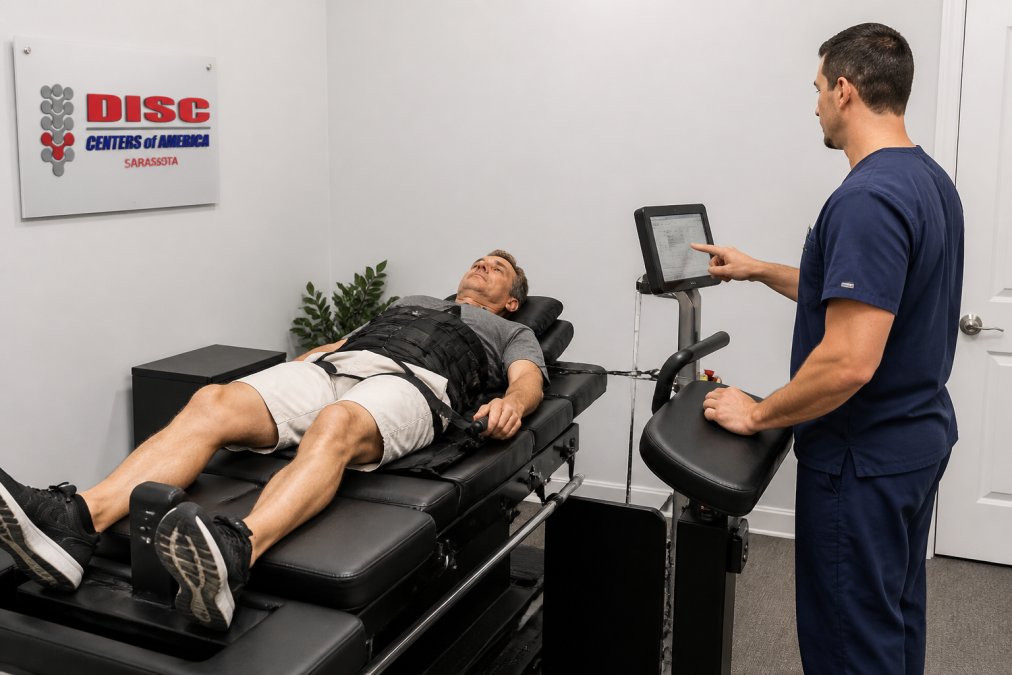
At Sarasota Disc Center, we target the specific source of pain rather than masking symptoms, treating herniated discs, bulging discs, sciatica, radiculopathy, spinal stenosis, and degenerative disc disease.
Unlike physical therapy (which strengthens muscles) or chiropractic adjustments (which target alignment), spinal decompression directly addresses disc pressure biomechanics, creating an environment for natural healing.
Non-Surgical Spinal Decompression Success Rate: What the Research Shows
Does spinal decompression really work? Yes, for the right patients. Success depends on patient selection, underlying condition, and treatment consistency. Clinical studies show variable outcomes because results depend heavily on diagnosis accuracy.
Studies show patients with herniated discs causing radiculopathy achieve higher symptom improvement rates than those with pure degenerative disc disease or facet joint syndrome. Success depends on matching treatment to the correct underlying pathology.
Success depends heavily on treatment compliance, patients completing their full course show better long-term outcomes than those stopping early.
Effective treatment requires proper patient selection. The condition must involve actual nerve impingement or disc herniation. If pain stems from muscle tension, poor posture, or facet joint arthritis without nerve involvement, spinal decompression won't address the root cause.
How Long Does Spinal Decompression Take to Work?
Most patients notice symptom improvement within 2-3 weeks, though initial pain reduction precedes structural healing. True therapeutic efficacy, where discs heal and symptoms stabilize long-term, typically takes 6-8 weeks of consistent treatment.
Acute conditions respond faster than chronic ones. Recent herniated discs causing sciatica improve quicker than chronic degenerative disc disease because the underlying pathology is simpler.
A typical schedule involves 3-4 sessions weekly for 4-6 weeks, with gradual spacing as you improve. Consistency is essential, missing appointments interrupts healing.
Post-treatment maintenance is critical. Many patients benefit from ongoing sessions spaced monthly or quarterly to maintain improvement and prevent recurrence.
Who Is a Candidate for Spinal Decompression?
Ideal candidates have imaging confirmation of nerve impingement or disc herniation, experience radiating arm or leg pain, and have failed conservative care like physical therapy or medication.
Age alone doesn't disqualify you. What matters is whether symptoms stem from nerve compression that decompression addresses. A 35-year-old with muscle tension won't benefit more than a 65-year-old with confirmed disc herniation.
Contraindications include pregnancy, severe osteoporosis, spinal fusion at the treatment level, active infection, and severe multi-level stenosis. Recent spinal surgery may require healing time before treatment begins.
Work and lifestyle matter practically.
CALL TODAY TO SCHEDULE YOUR FREE CONSULTATION →
Real Patient Outcomes and Limitations
Patient outcomes vary considerably, and honest assessment requires acknowledging both successes and limitations alongside the practical reality that treatment outcomes depend heavily on what happens after the formal therapy course ends.
Realistic Outcome Ranges
Some patients experience dramatic relief and return to abandoned activities. Others see 40-60% pain reduction. Roughly 15-25% experience minimal benefit, often due to diagnosis mismatch or conditions requiring surgery. Success typically correlates with acute herniated discs, full protocol completion, and activity modification adherence.
What Spinal Decompression Therapy Cannot Do
Spinal decompression therapy will not reverse severe arthritis, fix poor posture or weak core muscles, prevent recurrence if you return to original activities, resolve muscle tension pain, or provide predictable results for post-surgical patients. It reduces nerve pressure from existing degeneration but cannot restore lost disc height or cartilage.
The Critical Role of Post-Treatment Maintenance
The formal treatment course creates healing conditions, but maintaining improvement requires ongoing effort. Patients maintaining activity modification and periodic maintenance sessions achieve significantly better sustained outcomes than those stopping treatment and returning to previous habits.
Factors Predicting Better Long-Term Outcomes
Research and clinical experience identify several factors associated with sustained improvement:
- Completion of full treatment protocol: Patients who miss more than 2-3 sessions during the initial course show lower success rates.
- Age under 65: Younger patients show faster healing and better long-term outcomes, though age alone doesn't preclude success.
- Symptom duration under 12 months: Acute and subacute conditions respond better than chronic pain lasting years.
- Engagement in concurrent physical therapy: Patients who perform prescribed exercises during and after treatment maintain improvement better than those relying on decompression alone.
- Adherence to activity modifications: Patients who avoid heavy lifting and repetitive bending during the critical healing window show better outcomes.
- Realistic expectations: Patients expecting complete pain elimination sometimes feel disappointed by 70-80% improvement; those with realistic expectations report higher satisfaction.
Spinal Decompression vs. Other Conservative Treatments
Physical therapy strengthens muscles; chiropractic adjustments improve joint alignment; anti-inflammatory medications manage pain; epidural injections provide temporary nerve relief. Spinal decompression directly reduces mechanical nerve pressure and creates an environment for healing. Best outcomes combine approaches: decompression for nerve pressure, physical therapy for muscle strength, and activity modification for prevention.
| Treatment Type | Primary Mechanism | Best For | Timeline |
|---|---|---|---|
| Spinal Decompression | Reduces disc pressure via traction | Herniated/bulging discs with nerve compression | 4-8 weeks |
| Physical Therapy | Strengthens muscles, improves movement | General back health, prevention | 6-12 weeks |
| Chiropractic Care | Improves joint alignment and mobility | Joint restrictions, mobility issues | Ongoing |
| Epidural Injections | Reduces inflammation around nerves | Acute inflammatory pain | 2-12 weeks per injection |
| Anti-inflammatory Medication | Reduces swelling and pain signals | Symptom management | Days to weeks |
Cost, Timeline, and What to Expect
Treatment typically involves 3-4 sessions weekly for 4-6 weeks, requiring meaningful time and financial commitment. Each session lasts approximately 30 minutes of active treatment, plus 10-15 minutes for assessment.
Cost Breakdown and Insurance Coverage
Pricing for a full treatment course and individual sessions varies. Package discounts may be available.
What Happens During a Session
You remain fully clothed during treatment. Most describe it as gentle stretching; some fall asleep. Mild post-treatment soreness typically resolves within hours. Temporary increased pain in first 1-2 sessions usually subsides.
Activity Restrictions During Treatment
Your provider will give specific activity guidelines based on your condition. General restrictions during the treatment course include:
- Avoid heavy lifting: No loads over 10-15 pounds; this includes grocery bags, laundry baskets, and children
- Limit repetitive bending: Minimize activities requiring repeated forward flexion (gardening, vacuuming, loading/unloading vehicles)
- Reduce high-impact activity: Avoid running, jumping, or intense aerobic exercise; walking and swimming are typically safe
- Modify work tasks: If your job involves manual labor, discuss temporary duty modifications with your employer or provider
- Sleep positioning: Use a pillow that maintains neutral spine alignment; avoid stomach sleeping
Conclusion: Is Spinal Decompression Right for You?
Does spinal decompression really work? The honest answer is: it works for the right patients with the right conditions. If you have confirmed nerve impingement from a herniated or bulging disc, have experienced inadequate relief from physical therapy or medication, and want to avoid surgery, spinal decompression therapy deserves serious consideration.
Frequently Asked Questions
What is the reported success rate of non-surgical spinal decompression?
Clinical studies on non-surgical spinal decompression show variable success rates depending on patient selection and condition severity. Patients with herniated discs and radiculopathy tend to report the highest relief rates, while those with advanced degenerative disc disease or spinal stenosis may see more modest outcomes. Success is typically measured by pain reduction and functional improvement rather than complete disc healing. Individual results depend heavily on adherence to treatment protocols and post-treatment maintenance.
How long does spinal decompression treatment typically take to show results?
Most patients begin treatment protocols lasting 4 to 8 weeks, with sessions several times per week. Some patients report symptom improvement within the first 2 to 3 weeks, while others require the full treatment course before experiencing significant relief. The timeline varies based on condition severity, disc herniation size, and how long symptoms have been present. Post-treatment maintenance exercises and lifestyle modifications affect how quickly and sustainably results appear.
Can spinal decompression permanently cure a herniated disc?
Spinal decompression does not permanently 'cure' herniated discs in the sense of restoring the disc to its original state. Instead, it reduces pressure on affected nerves, allowing the disc material to retract naturally and inflammation to decrease. Many patients experience lasting pain relief and restored function, but ongoing maintenance, including targeted exercises, posture correction, and activity modification, helps prevent recurrence. Some patients may require periodic maintenance sessions if symptoms return.
Who is a good candidate for spinal decompression therapy?
Candidates for spinal decompression typically include patients with herniated discs, bulging discs, sciatica, radiculopathy, or mild to moderate spinal stenosis who have failed conservative care like physical therapy. Ideal candidates are those without severe osteoarthritis, active infection, or unstable spinal fractures. Age is less important than overall spinal health and symptom profile. A consultation with a qualified healthcare provider and imaging review (MRI or CT scan) determines individual candidacy.
Is spinal decompression safe, and what are the main risks?
Non-surgical spinal decompression is generally considered safe when performed by trained professionals on appropriate candidates. Mild side effects like temporary muscle soreness or increased symptoms are possible during early treatment. Serious complications are rare but can include nerve irritation or disc herniation progression if the patient is not properly screened. Contraindications include pregnancy, certain fractures, severe osteoporosis, and active spinal infections. A thorough evaluation before treatment minimizes risk.