 How-to
How Long Does Spinal Decompression Take?
Last Updated: November 2, 2026
Quick Summary
A typical nonsurgical spinal decompression session lasts about 20 to 30 minutes, but the full treatment course is spread over several weeks. Your provider will set the number of visits after an individual evaluation of your condition. Surgical decompression takes a different amount of time, usually one to several hours depending on the procedure.
- A nonsurgical session usually runs about 20 to 30 minutes on the table.
- Treatment is typically delivered as a course spread across several weeks.
- Visit frequency often drops as symptoms improve.
- Surgical decompression can range from under an hour to several hours.
- Lumbar surgery recovery milestones are set by your surgeon's written restrictions.
Table of Contents
- What Spinal Decompression Is and Why Duration Varies
- How Long a Single Nonsurgical Spinal Decompression Session Lasts
- Spinal Decompression Therapy Sessions: How Many Visits Are Typically Scheduled
- How Many Spinal Decompression Treatments Are Needed for Lasting Relief
- How Long Decompression Surgery Takes and the Hospital Stay Afterward
- Lumbar Decompression Surgery Recovery Time and Return to Work or Driving
- Spinal Decompression Therapy Results and Realistic Expectations on Your Timeline
- Frequently Asked Questions
What Spinal Decompression Is and Why Duration Varies
Spinal decompression is a non-surgical treatment that gently stretches the spine to take pressure off discs and nerves. The question patients ask most often is simple: how long does spinal decompression take? The honest answer depends on what you are measuring. A single appointment, a full course of care, and the recovery after surgery are three very different timelines.
Patients often mix these up, so it helps to separate them early. The session itself is the time you spend on the table. The treatment course is the number of visits spread over weeks. Recovery is the time your body needs to heal and get back to normal activity. Each one follows its own clock.
Several factors change how long each stage runs. The severity of the disc problem matters. So does how long the pain has been present, your age, and how your body responds. Many of these details can only be sorted out in a consultation, not in a general article.
- Session time: how long you are on the table for one visit
- Treatment course: how many visits are planned over weeks
- Recovery time: how long healing takes after the care ends or surgery
How Long a Single Nonsurgical Spinal Decompression Session Lasts
Most nonsurgical sessions are short, and the traction itself is only part of the visit. Session length depends on the treatment plan, and your provider will confirm the expected time for your case. Expect to arrive a few minutes early for paperwork and positioning.
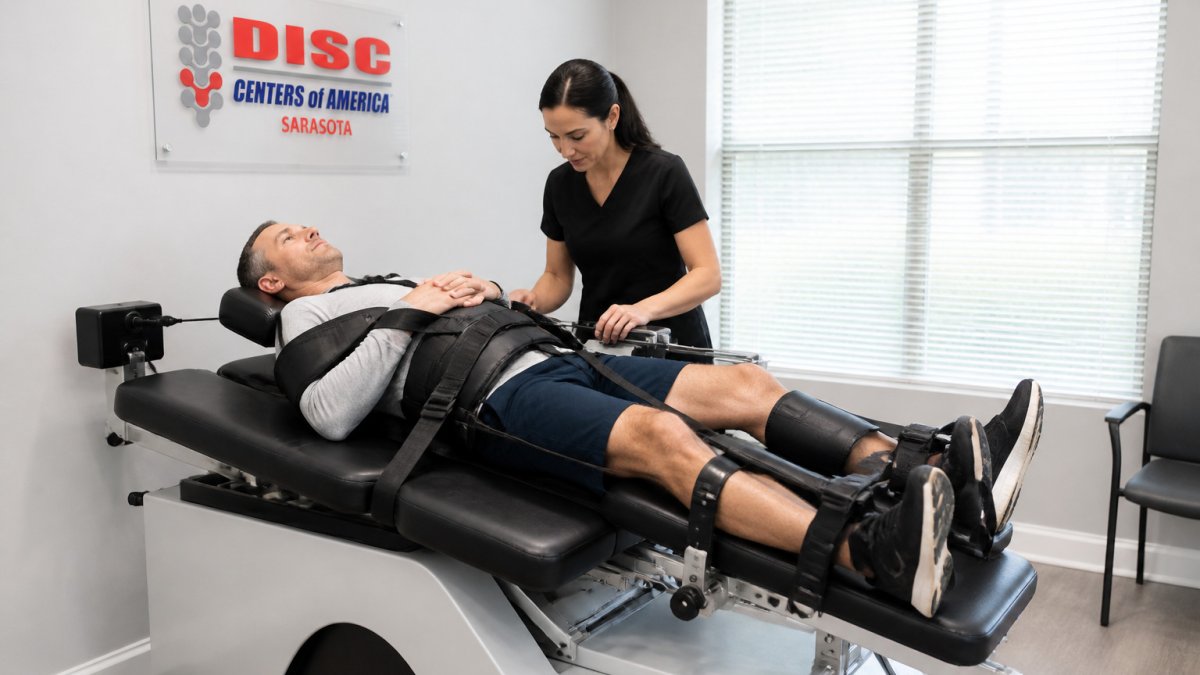
During a visit, you lie on a treatment table while gentle, controlled stretching is applied to the spine. Your provider will explain what to expect during your care.
Here is what a single visit usually includes:
- Check-in and a short review of your symptoms
- Positioning on the table with support pads
- The decompression cycle, usually 20 to 30 minutes
- A brief check after the session before you go home
Spinal Decompression Therapy Sessions: How Many Visits Are Typically Scheduled
Treatment is often delivered as a course spread across several weeks. A plan is individualized, and your provider will recommend a schedule after a personal evaluation.
Visit frequency often changes as symptoms improve. Breaks between visits give the body time to respond, and a steady rhythm tends to work better than cramming appointments together. Missing visits can slow progress, so planning your schedule early helps.
Ask your provider to explain the full visit plan before you start. A clear plan makes it easier to fit care around work and family.
- Expect a course rather than a single appointment
- Visit frequency often drops as you improve
- Your plan is set after an individual evaluation
How Many Spinal Decompression Treatments Are Needed for Lasting Relief
The number of treatments needed varies from person to person. Your provider will monitor your progress and adjust the plan as needed.
Lasting relief depends on more than the number of sessions. Keeping up with the recommended schedule, staying active within your limits, and following your provider's home advice all play a role. Stopping early because you feel a little better can leave the problem partly unresolved.
Because outcomes differ, no general article can promise a specific count. A consultation is the best way to learn what a realistic course looks like for your condition.
- Progress is tracked at each visit
- Schedules are adjusted based on response
- Following the plan supports more durable results
How Long Decompression Surgery Takes and the Hospital Stay Afterward
Surgical decompression is a different process with its own timeline, and the duration depends heavily on the procedure type, the number of spinal levels treated, and whether the surgeon uses a minimally invasive or open approach. Unlike nonsurgical therapy, where session length is fairly consistent, surgical time can range from under an hour to several hours.
Here is a practical breakdown of what to expect for common decompression procedures:
- Lumbar laminectomy (open): Typically 1 to 2 hours for a single level; longer if multiple levels are involved. Hospital stay is often 1 to 3 nights.
- Lumbar laminotomy or foraminotomy (minimally invasive): Often 45 minutes to 1.5 hours. Many patients go home the same day or after one night.
- Microdiscectomy: Usually 1 to 1.5 hours. Same-day discharge is common.
- Cervical decompression (e.g., anterior cervical discectomy and fusion): Often 1 to 2 hours. Hospital stay is typically 1 to 2 nights.
These are general ranges; your surgeon will give you a specific estimate based on your imaging and health history. The hospital stay is influenced by how well you recover from anesthesia, your pain control, and whether you have support at home.
Surgical decompression is a medical decision made with your surgeon. Nonsurgical care is one option to discuss with your provider before choosing surgery. (Source: factors influencing treatment success)
CALL TODAY TO SCHEDULE YOUR FREE CONSULTATION →
The table below sums up the typical operating time and hospital stay for the common decompression procedures covered above.
| Procedure | Typical operating time | Typical hospital stay |
|---|---|---|
| Lumbar laminectomy (open) | 1 to 2 hours for one level | 1 to 3 nights |
| Lumbar laminotomy or foraminotomy | 45 minutes to 1.5 hours | Same day or one night |
| Microdiscectomy | 1 to 1.5 hours | Same-day discharge common |
| Cervical decompression (ACDF) | 1 to 2 hours | 1 to 2 nights |
Lumbar Decompression Surgery Recovery Time and Return to Work or Driving
Recovery after lumbar decompression surgery varies by procedure, overall health, and how well postoperative instructions are followed. Your surgeon will provide the specific timeline for your case.
First 24-48 hours: Most patients are encouraged to walk short distances soon after surgery. You may need help with dressing and meals. Pain is managed with medication, and you may be discharged the same day or after one night.
First 1-2 weeks: Walking distance increases. You should avoid bending, twisting, and lifting anything heavier than about 5-10 pounds (Spine surgery). Desk-based work may be possible if you can sit comfortably and your surgeon agrees. Driving is usually not permitted while you are taking opioid pain medication or if you cannot react quickly.
Weeks 2-6: Many patients return to light-duty work and resume driving once they are off pain medication and can sit, turn, and brake without pain. Physical therapy often begins during this window to strengthen the back and improve flexibility.
Weeks 6-12: Return to more demanding physical work and recreational activities is often gradual. Heavy lifting and high-impact activities are typically restricted until cleared by your surgeon.
Beyond 3 months: Full recovery may take several months, and some patients continue to see improvement in strength and endurance for up to a year.
Practical planning tips:
- Arrange transportation for the first week, especially if driving is restricted.
- Prepare your home before surgery: clear walkways, set up a recovery station, and stock easy meals.
- Ask your surgeon for a written return-to-work and driving timeline so you can coordinate with your employer.
- Keep follow-up appointments; they are used to adjust activity restrictions.
A clear, milestone-based plan makes recovery more predictable and helps you avoid the common mistake of doing too much too soon.
Spinal Decompression Therapy Results and Realistic Expectations on Your Timeline
Results from nonsurgical decompression can build gradually over time, and timelines differ between individuals. Setting realistic expectations helps you judge progress without giving up too early.
Nonsurgical care supports the body's healing over time, and improvement can occur in stages. Tracking your pain, sleep, and mobility each week can show progress that is easy to miss day to day.
Bring your questions to your provider. A clear, personal timeline is more useful than any general estimate, and a consultation can tell you what to expect for your condition. You can contact Disc Centers of America in Sarasota FL to ask about your specific case.
- Improvement often comes in gradual stages
- Track pain, sleep, and movement each week
- Discuss your personal timeline at a consultation
Ready to learn what your timeline may look like? Call for a FREE MRI Review and Consultation at Sarasota Disc Center. Dr. David Cifra and our team will review your condition and explain your options in plain terms.
Frequently Asked Questions
How long does a non-surgical spinal decompression session take?
Session length depends on your treatment plan, and your provider at Sarasota Disc Center can confirm the expected time during a consultation. The actual table time is only part of the visit, so plan for some additional time for check-in and paperwork. Exact session length depends on your treatment plan, and your provider at Sarasota Disc Center can give you the specifics for your situation during a consultation.
How many spinal decompression therapy sessions are typically needed?
Treatment plans are individualized, so the number of sessions depends on the condition being treated, how long symptoms have been present and how you respond. Plans are often delivered as a course of several weeks, with sessions spaced over that period. Your provider will reassess progress along the way and adjust the plan as needed. A free MRI review and consultation with Sarasota Disc Center is the best way to learn what a realistic course would look like for you.
How long does it take to recover from lumbar decompression surgery?
Recovery after lumbar decompression surgery varies with the procedure type, the number of levels treated and individual health factors. Many patients go home within a day or two, and returning to light activity usually comes first. Full recovery often takes several weeks to months, and driving and work restrictions depend on your surgeon's guidance. Because surgery is a major decision, discuss the expected timeline and restrictions with your surgical team before proceeding.
How long after spinal decompression can you drive?
Driving guidance depends on whether you had nonsurgical decompression or surgery. Nonsurgical sessions generally do not carry the same driving restrictions as surgery, but any treatment that leaves you sore or affects your comfort should be considered before getting behind the wheel. After surgery, most surgeons restrict driving for a period while the spine heals, and that period is set by your surgeon. Ask your provider directly so you know what applies to your case.