 How-to
How to Choose Non-Invasive Back Treatment That Works
Quick Summary
Non-invasive back treatment means care that does not cut into the body or put anything inside it. Its main benefits are no surgical wound, no anesthesia or hospital stay, preserved muscle and ligament anatomy, and the ability to keep working in most cases.
- Non-invasive means nothing enters the body; non-surgical means no operation, and the two terms are not identical.
- Benefits such as no incision and no hospital stay apply to conservative care broadly, including physical therapy and exercise programs.
- Spinal decompression, chiropractic adjustment and medication differ in evidence and results, so benefits depend on your diagnosis.
- Set a review point of about four to six weeks to decide whether conservative care is working before escalating.
- Seek urgent evaluation for progressive leg weakness, saddle numbness, or bladder or bowel changes rather than continuing routine care.
Table of Contents
- What Non-Invasive Back Treatment Actually Means
- The Benefits of Non-Invasive Back Treatment for Chronic Pain
- Non-Invasive Spinal Decompression: How It Works and Who It Suits
- Non-Surgical Back Pain Treatment Options Compared
- Herniated Disc Treatment Without Surgery and Sciatica Relief
- Sciatica Treatment Without Surgery: Realistic Timelines and Outcomes
- Booking Your Free MRI Review and Consultation
- Frequently Asked Questions
What Non-Invasive Back Treatment Actually Means
Last Updated: November 1, 2026
Non-invasive back treatment means care that does not cut into the body or put anything inside it. Complementary approaches often integrate mechanical decompression with targeted therapy for chronic pain to address the underlying neurological and muscular components of persistent discomfort.
The phrase gets used loosely, so it helps to define it. MedlinePlus overview of back pain treatment options describes conservative care as a first step for most back problems, before surgery is considered.
Non-surgical, non-invasive and minimally invasive: how they differ
These three terms sound alike, but they mean different things:
- Non-surgical means no operation. Treatments like medication, physical therapy, and spinal decompression fall here.
- Non-invasive means nothing enters the body. Massage, heat, and external devices are examples.
- Minimally invasive means a surgeon uses small incisions or tubes. This is still surgery, with its own risks.
A treatment can be non-surgical and still use a machine. The label matters less than the question you ask: "Does this procedure cut into my body?" If the answer is no, you are looking at a non-invasive option.
The Benefits of Non-Invasive Back Treatment for Chronic Pain
Most pages that rank for this keyword list the same benefits: no incision, less pain, faster recovery. That list is accurate, but it is also incomplete, because it blends together treatments that work very differently. The benefits below are grouped by what the evidence actually supports, with the trade-offs attached. Read the evidence and outcomes review of whether spinal decompression works for more detail.
Benefits that are well established across conservative care
These hold for physical therapy, activity modification, and structured exercise programs, which most clinical guidelines place first for uncomplicated back pain:
- No surgical wound, so no surgical site infection risk and no blood loss. This is a structural advantage, not a statistical one: if nothing is cut, there is nothing to infect or bleed.
- No anesthesia exposure and no hospital stay. Care happens in an office or clinic, and you go home the same day.
- Preserved muscle and ligament anatomy. Open spine surgery cuts through back muscles and detaches tissue to reach the spine; non-surgical care does not, which matters because those tissues stabilize the spine.
Benefits that are procedure-dependent, not universal
This is where most benefit lists overreach. Spinal decompression, chiropractic adjustment, and traction are all non-surgical, but their evidence base and their effect sizes differ, and results vary by diagnosis:
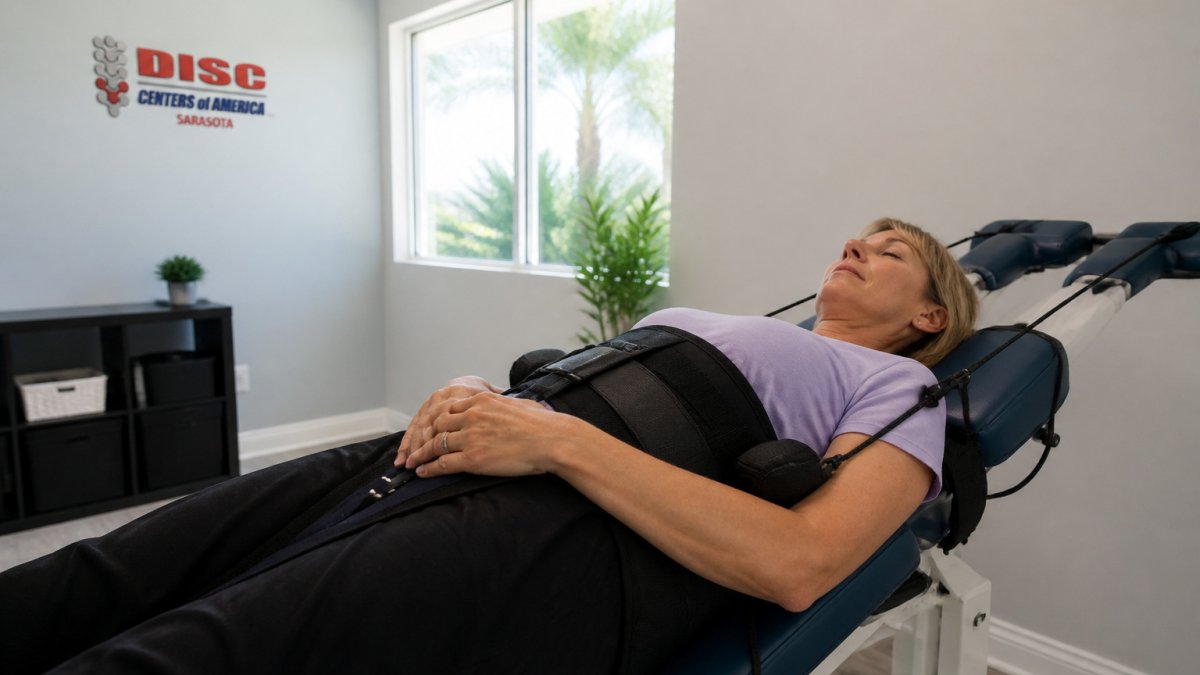
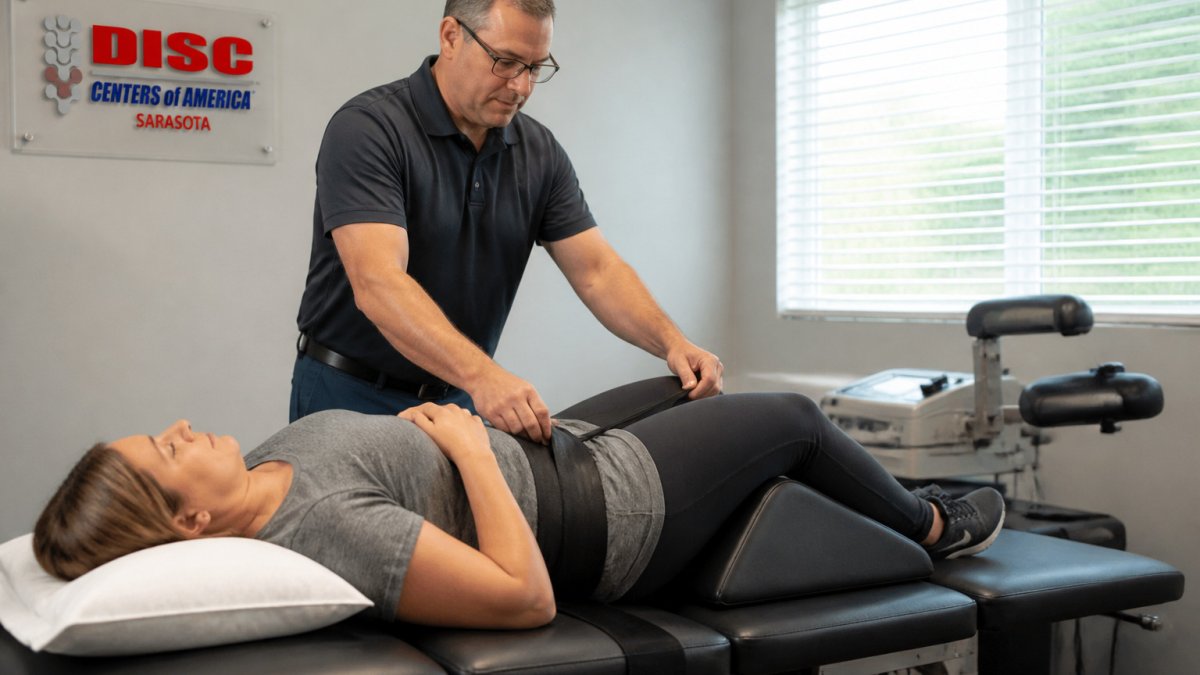
- Spinal decompression aims to unload disc and nerve pressure through controlled traction. Whether it is suitable depends on the diagnosis, and a clinical assessment is needed to decide.
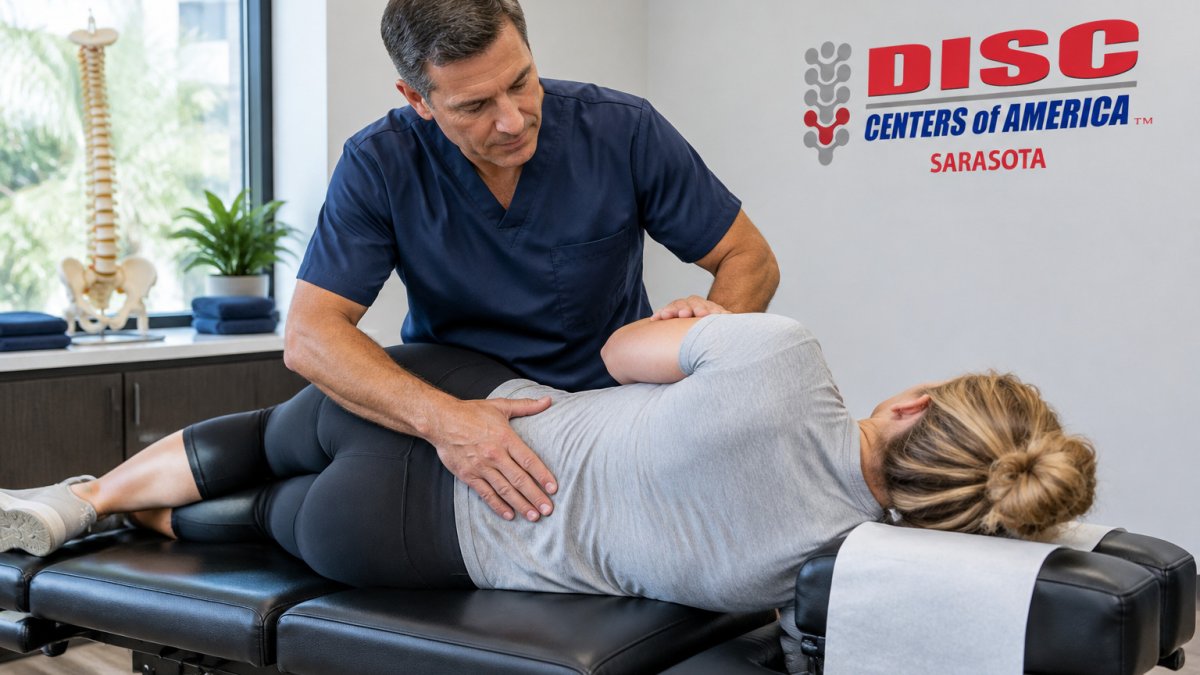
- Chiropractic adjustment focuses on joint motion and can improve short-term pain and function for some mechanical back pain. It is not a treatment for nerve compression caused by a disc or bone spur, and it requires ongoing visits for many patients.
- Medication reduces pain and inflammation but does not change the underlying mechanical problem, and long-term use of some pain relievers carries its own risks.
A benefit is only real for you if it applies to your diagnosis. Ask your provider: "What is the evidence for this specific treatment in patients with my specific finding on imaging?" A good answer will name the condition, not just the treatment.
The trade-offs competitors leave out
- Time. Non-invasive care is not instant. A typical course runs several weeks, and chronic pain that developed over months rarely resolves in a handful of visits.
- Out-of-pocket cost. Many conservative treatments, including spinal decompression, are not covered by all insurance plans, so ask for the cash price and a written treatment plan before you start.
- Delayed diagnosis. The biggest risk of any non-invasive path is not the treatment itself, it is waiting too long on a problem that needs imaging or a specialist. New leg weakness, numbness in the groin, or loss of bladder or bowel control are reasons to seek urgent evaluation, not to book another session.
What the benefits are not
Non-invasive treatment is not a guarantee of avoiding surgery. A meaningful share of patients who try conservative care still end up discussing surgery, and that is not a failure of the non-invasive approach, it is a sign that the diagnosis called for a different tool.
Non-Invasive Spinal Decompression: How It Works and Who It Suits
Spinal decompression is a non-surgical treatment that aims to reduce pressure on spinal discs and nerves. Learn how non-surgical spinal decompression is applied for sciatica and nerve pain in Sarasota.
It tends to suit people with:
- Chronic back or neck pain
- Herniated or bulging discs
- Sciatica that has not responded to other care
It may not suit everyone. People with certain fractures, infections, tumors, or severe spinal instability often need a different plan. A clinical assessment is the only way to know whether you are a candidate.
Non-Surgical Back Pain Treatment Options Compared
Most comparison sections list options side by side and leave you to guess the order. Review the clinical studies on non-surgical spinal decompression to check the research behind each option. A more useful approach is a stepwise pathway: start with the least invasive option that fits your diagnosis, measure whether it is working, and move up only when it is not.
CALL TODAY TO SCHEDULE YOUR FREE CONSULTATION →
| Option | What it targets | Typical course | Best fit | Main limitation |
|---|---|---|---|---|
| Activity modification and self-care | Acute flare, muscle strain | Days to a few weeks | New, uncomplicated back pain | Not enough for nerve compression or structural problems |
| Physical therapy | Strength, mobility, movement confidence | Several weeks, often 2 to 3 visits per week | Mechanical and muscle-related pain; post-flare rehab | Takes time and consistent effort |
| Chiropractic adjustment | Joint motion and alignment | A trial of visits, then reassess | Mechanical back pain without nerve compression | Results vary; ongoing visits common |
| Medication | Pain and inflammation | Short-term, as directed | Bridge therapy during a flare | Does not address the cause; long-term risks |
| Spinal decompression | Disc and nerve pressure | A planned series of sessions over weeks | Contained disc bulge or herniation with sciatica | Not for severe stenosis, instability, or fracture |
| Epidural steroid injection | Nerve inflammation | One to a few injections | Radicular pain that has not settled | Temporary relief for many; procedure-related risks |
How to move through the pathway
- Get a diagnosis first. A history and physical exam are the starting point; imaging is used when symptoms suggest nerve involvement or when conservative care is not working. Treating without a diagnosis is how people spend months on the wrong therapy.
- Start with the least invasive option that fits. For most uncomplicated back pain, that is activity modification plus physical therapy. Guidelines from major clinical bodies consistently place these before injections and surgery.
- Set a review point. Agree with your provider on a date, typically four to six weeks, to decide whether the approach is working. Without a review point, conservative care can drift into indefinite care.
- Escalate based on findings, not frustration. If pain is unchanged and imaging shows a disc herniation compressing a nerve, a targeted non-surgical treatment such as decompression or an injection is a reasonable next step. If imaging shows severe stenosis or instability, the conversation shifts toward surgical consultation.
- Know when to stop escalating and get evaluated urgently. Progressive leg weakness, saddle numbness, or bladder or bowel changes are red flags that call for same-day medical assessment, not another appointment in the series.
Recovery timelines by option
These are typical ranges, not promises, and they depend on diagnosis, age, and how long the problem has been present:
- Physical therapy: meaningful change often appears in 4 to 6 weeks; full strengthening takes longer.
- Chiropractic: a short trial of visits is common, with reassessment before committing to ongoing care.
- Spinal decompression: a planned series over several weeks, with progress reviewed partway through rather than assumed.
Cost and coverage questions to ask
Pricing for non-surgical care varies widely by market and provider, so no universal figure is meaningful. Instead, ask these questions before you commit:
- Is this treatment covered by my plan, and if not, what is the cash price per session and for the full course?
- How many sessions are in the recommended plan, and what happens if I am not improving at the midpoint?
- Will I get a written diagnosis and treatment plan I can share with another provider for a second opinion?
Be cautious with any provider who guarantees a outcome, sells a large prepaid package before a diagnosis, or discourages you from getting a second opinion. A legitimate non-surgical plan is built around your diagnosis and has a defined review point.
Who may not be a candidate
Non-surgical care is not appropriate for everyone. People with spinal infection, tumor, fracture, severe instability, or progressive neurologic deficit need medical or surgical evaluation, not a course of conservative therapy. Pregnancy, implanted devices, and some medical conditions may also rule out specific treatments such as certain types of traction or adjustment. A clinical assessment is the only reliable way to know which options fit you.
Herniated Disc Treatment Without Surgery and Sciatica Relief
A herniated disc can press on a nerve and cause pain that travels down the leg. This is often called sciatica. Read the non-surgical herniated disc treatment guide for detailed options.
Here is a practical way to think about your options:
- Start with an accurate diagnosis, usually including your history and imaging.
- Try conservative care such as physical therapy or medication.
- If pain persists, ask about targeted non-surgical treatments.
- Discuss surgery only if symptoms are severe or getting worse.
Watch out: waiting too long can allow nerve symptoms, such as numbness or weakness, to become harder to reverse. Report new leg weakness or loss of bladder control to a doctor right away.
Sciatica Treatment Without Surgery: Realistic Timelines and Outcomes
Recovery time depends on the cause and severity of the problem. See non-surgical sciatica treatment options available in Sarasota and what each involves. Mild sciatica often improves within several weeks with conservative care. Longer-lasting or more severe cases may take months.
Realistic expectations help you stay committed. Ask your provider for a clear plan and a way to measure progress.
Booking Your Free MRI Review and Consultation
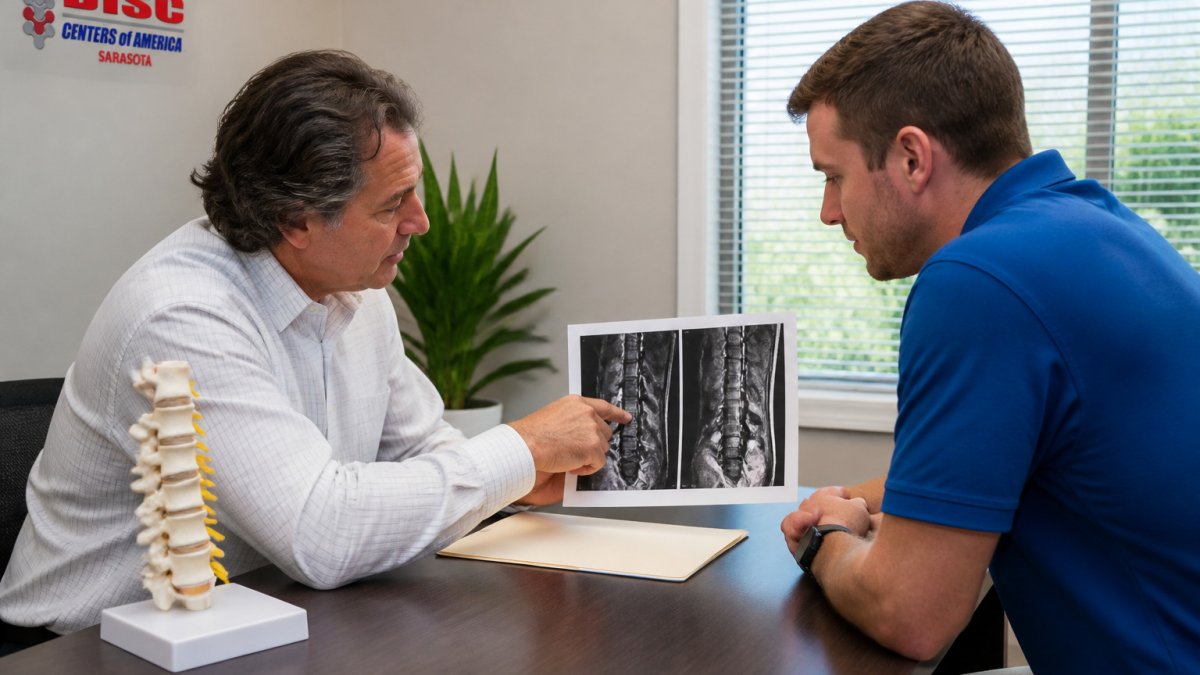
If you have chronic back or neck pain and want to explore non-surgical options, a consultation is a good next step. At Sarasota Disc Center, Dr. David Cifra is available for a consultation to discuss whether non-invasive care may be appropriate. Call to schedule a FREE MRI Review and Consultation.
Frequently Asked Questions
What is non-invasive spinal decompression?
Non-invasive spinal decompression is a non-surgical treatment that applies traction to the spine. The goal is to reduce pressure on a disc and nearby nerves. Outcomes vary by condition, and a clinical assessment, including a review of imaging, determines whether it is a reasonable option. A qualified provider can explain whether it fits your situation.
Can non-surgical back pain treatment help with a herniated disc or sciatica?
Some people with herniated discs or sciatica find relief through non-surgical care, including traction-based decompression, physical therapy and medical management. Whether it helps depends on the location and severity of the problem, how long symptoms have lasted and whether there is significant nerve compression or a neurological deficit. Certain warning signs, such as progressive weakness or loss of bladder or bowel control, require urgent medical evaluation. A consultation with a qualified professional is the best way to find out what is appropriate for you.
How long does non-invasive back treatment take to work?
Timelines vary widely by condition, how long the problem has been present and the treatment plan chosen. Many people with chronic back or neck pain need a series of visits over several weeks before noticing meaningful change, and some conditions take longer. Your provider should set expectations at the start and reassess progress regularly. If symptoms are not improving as expected, it is reasonable to revisit the plan with your provider.
When should back pain be evaluated by a medical professional?
Seek prompt medical evaluation if back or neck pain follows a serious injury, comes with fever, unexplained weight loss, or numbness or weakness that is spreading or worsening. Loss of bladder or bowel control, or numbness in the groin area, is a medical emergency. Pain that persists beyond a few weeks, or that disrupts sleep and daily activities, also warrants a professional assessment. Only a qualified clinician can determine the cause of your symptoms.