 blog
Chiropractic vs Physical Therapy for Herniated Discs
Last Updated: November 12, 2026
Quick Summary
Chiropractic care and physical therapy both treat herniated discs without surgery, but they work differently. Chiropractic care uses spinal manipulation mainly to ease pain and improve joint motion, while physical therapy builds strength and movement through targeted exercise. Physical therapy has broader support for lasting function, and the right choice depends on your exam findings.
- Chiropractic care mainly targets short-term pain relief and joint motion through spinal manipulation.
- Physical therapy focuses on exercise-based rehabilitation for strength, mobility, and longer-term function.
- Exercise-based rehabilitation has broader support for reducing recurrence in lumbar disc-related pain.
- Poorly matched manipulation carries risk, especially with a large bulge or existing nerve compression.
- Saddle numbness, bowel or bladder changes, or progressive weakness require same-day medical evaluation.
Table of Contents
- What a Herniated Disc Does to Your Spine and Nerves
- How Chiropractic Care Approaches a Herniated Disc
- Physical Therapy Exercises for a Herniated Disc
- Chiropractic vs Physical Therapy: Side-by-Side Comparison
- Chiropractor Care for an L5-S1 Herniated Disc: What to Expect
- Non-Surgical Treatment for a Herniated Disc: Red Flags and Next Steps
- Booking Your Free MRI Review and Consultation at Sarasota Disc Center
- Frequently Asked Questions
What a Herniated Disc Does to Your Spine and Nerves
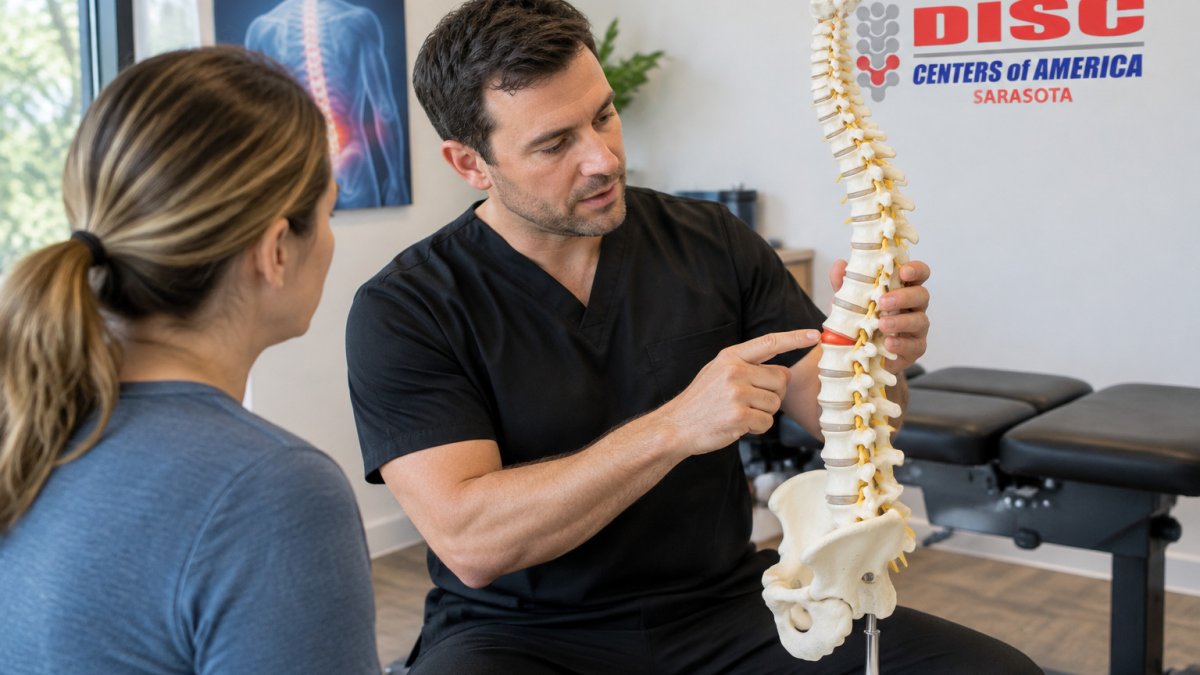
A herniated disc is a spinal disc whose soft, jelly-like center pushes through its tougher outer ring. When that happens, the bulge can press on a nearby nerve root.
The key point is that the disc itself is often not the whole story. Inflammation, muscle guarding, and reduced movement can all keep pain going even after the original injury begins to settle.
How Chiropractic Care Approaches a Herniated Disc
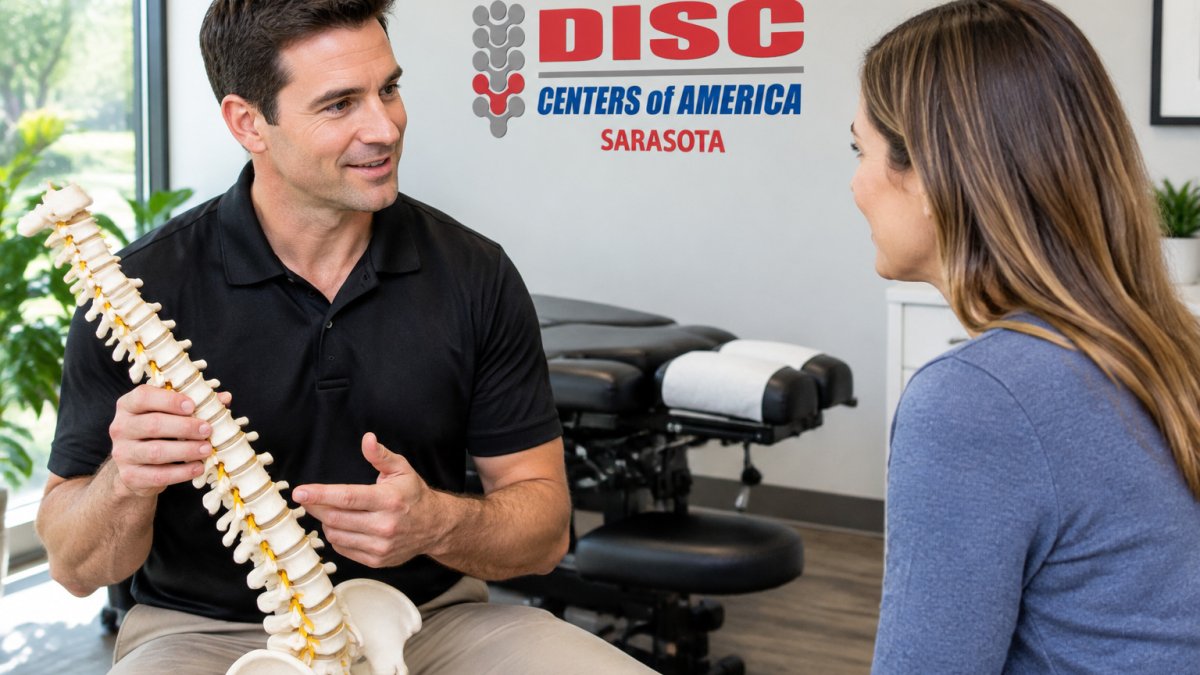
Chiropractic care centers on the spine and the nervous system. The most recognized technique is spinal manipulation, a controlled, quick movement applied to a joint.
Spinal manipulation and what it aims to do
Spinal manipulation is meant to improve joint motion and ease muscle tension around the affected area. See how chiropractic adjustment differs from spinal decompression for a closer look at the two methods. The goal is mainly symptom control rather than rebuilding strength on its own. Because the effects often fade without follow-up work, chiropractic care is usually most useful as one part of a broader plan.
Can a chiropractor make a herniated disc worse?
This is a fair concern, and the honest answer depends on the specific case. Aggressive or poorly matched manipulation carries a risk, particularly when a disc is large or a nerve is already compressed. Watch for these warning signs after any adjustment:
- Pain that spreads into a leg or arm
- New numbness, tingling, or weakness
- Loss of bladder or bowel control, which needs emergency care
A qualified clinician should evaluate these symptoms before any manipulation begins. Ask about imaging and the specific technique planned.
Physical Therapy Exercises for a Herniated Disc
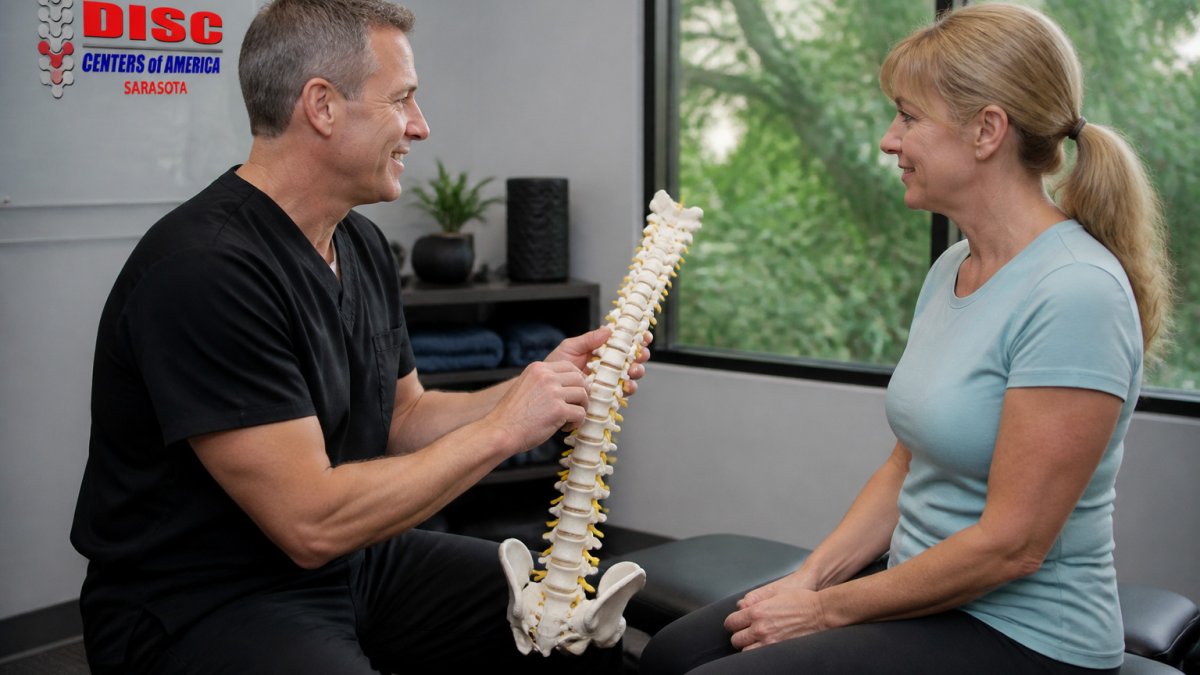
Physical therapy takes a more active approach. A therapist designs a program of targeted exercises, stretches, and movement training. The aim is to reduce pain while building the muscles that support the spine.

Strength, mobility and longer-term rehabilitation goals
Early physical therapy often focuses on gentle movement that the patient can tolerate. Over time, the work shifts toward core strengthening, flexibility, and safe lifting mechanics. Physical therapy tends to be slower to produce immediate relief, but its benefits can last longer when the patient keeps up the exercises at home. Compare spinal decompression with physical therapy to see how the two approaches differ in practice.
Chiropractic vs Physical Therapy: Side-by-Side Comparison
Both approaches are conservative and both are commonly used for herniated discs. They are not interchangeable, and the comparison is less about which one wins and more about what each is good at and how the two may fit together.
| Factor | Chiropractic Care | Physical Therapy |
|---|---|---|
| Main approach | Spinal manipulation and other manual techniques, plus exam and imaging review | Targeted exercise, movement training, and graded loading |
| Primary goal | Reduce pain and restore joint motion in the short term | Build strength, mobility, and tolerance for daily activity |
| Typical early course | A short trial of visits with reassessment | An evaluated program with a home exercise component from the start |
| Evidence picture | Manual therapy and manipulation have modest support for short-term pain and function in some back pain populations; disc-specific evidence is thinner | Exercise-based rehabilitation has broader support for improving function and reducing recurrence in lumbar disc-related pain |
| Main risk | Poorly matched or aggressive manipulation, especially with a large bulge or existing nerve compression | Doing too much too soon, or progressing load before symptoms settle |
| Best fit | Pain and stiffness limiting movement, no neurological deficit, after a proper exam | Weakness, deconditioning, recurrent episodes, or a need for a durable self-management plan |
What the evidence supports, and where it is uncertain
The strongest evidence in this area is for active rehabilitation: graded exercise and movement-based physical therapy have reasonably consistent support for improving function and reducing the chance of recurrence in people with lumbar disc-related pain. Manual therapy, including spinal manipulation, has more modest support, mainly for short-term pain relief and improved motion in some back pain populations. Disc-specific studies are fewer and often small, and many combine manipulation with exercise rather than testing it alone.
Combining care and coordinating clinicians
For many patients the most effective plan is not one or the other but a sequence.
Watch out: combining treatments without communication can mean duplicated visits, conflicting instructions, and a bill that adds up faster than the benefit. A shared checkpoint also makes it easier to weigh whether an injection belongs in the plan, using a comparative study on treatment options to frame that discussion.
How to choose when you are the one deciding
The practical tiebreakers are usually these: if your main problem is pain and stiffness limiting movement and your exam shows no neurological deficit, a short trial of chiropractic care with a clear reassessment point is reasonable. If your main problem is weakness, deconditioning, or a pattern of recurring episodes, physical therapy is the better starting point. If you have progressive weakness, saddle numbness, or bowel or bladder changes, neither is the right first step, get medically evaluated.
Chiropractor Care for an L5-S1 Herniated Disc: What to Expect
An L5-S1 herniated disc sits at the base of the spine, where it can affect the sciatic nerve and cause pain in the buttock, back of the leg, or foot. Care for this level often starts with a clear diagnosis and a conservative plan. A chiropractor may use adjustments to ease pain, but should also discuss how the treatment will progress and when to reassess.
Non-Surgical Treatment for a Herniated Disc: Red Flags and Next Steps
Many herniated discs improve over time with conservative care, and a clinician can help you understand what to expect for your own condition. The reason red flags matter is that a small minority of disc herniations do not follow it, and the ones that don't need a different kind of attention than an adjustment or an exercise handout.
Symptoms that mean stop and get evaluated now
These are not "maybe mention it at your next visit" symptoms. They are reasons to seek urgent or emergency medical care the same day:
- Saddle numbness. Numbness or altered sensation in the groin, inner thighs, or the area that would touch a bicycle saddle. This points to compression of the sacral nerve roots rather than a single nerve root.
- Bowel or bladder changes. New inability to urinate, loss of bladder control, or loss of bowel control. Inability to urinate is often the earlier and more telling sign.
- Progressive weakness. Not weakness that comes and goes with pain, but a leg that is getting steadily weaker, foot drop, difficulty lifting the foot, or a knee that buckles. Progressive means worsening over hours to days, not fluctuating with activity.
These findings together suggest cauda equina syndrome, a rare but time-sensitive compression of the nerve bundle at the base of the spine. It is generally treated as a medical emergency, and delay can lead to lasting problems. The distinction that matters for a reader is this: routine disc pain radiates down one leg and varies with position; the red-flag picture is bilateral, involves the saddle area or bowel and bladder function, or is steadily worsening.
Symptoms appropriate for routine conservative care
Most people with a herniated disc fall into a different bucket: pain that radiates down one leg or arm, tingling or numbness in a predictable pattern, pain that is worse with sitting, bending, or coughing, and symptoms that are uncomfortable but stable or slowly improving. That pattern is what chiropractic care and physical therapy are designed to address. It does not require emergency evaluation, but it does require a proper exam, including a neurological screen of strength, sensation, and reflexes, before anyone manipulates the spine or prescribes loading exercises.
A practical next-step pathway
The useful question is not "chiropractic or physical therapy" in the abstract. It is what your exam and imaging actually show. A reasonable sequence looks like this:
- Get a diagnosis, not just a label. A clinician should test strength, sensation, and reflexes and review any MRI in context. Imaging findings are common in people without pain, so a disc bulge on a report does not by itself explain your symptoms (NICE).
- Match the plan to the finding. A small bulge with mild radiating pain and no neurological deficit is a very different problem from a large extrusion with measurable weakness. The first tolerates a trial of manual therapy or exercise; the second usually warrants medical evaluation before any hands-on spinal treatment.
- Set a reassessment point up front. Ask each provider how many visits they expect before deciding whether the plan is working, and what specific change, pain level, distance walked, strength test, will tell you. A clinician may suggest a short trial period with a clear checkpoint.
- Change course if the checkpoint is missed. If pain is not trending down and function is not improving by that point, the plan should change rather than continue on momentum.
- Escalate if a red flag appears at any time. New weakness, saddle numbness, or bowel or bladder changes override the plan and mean same-day medical contact.
What progress actually looks like
Early improvement is usually measured in tolerance rather than cure: sitting longer, walking farther, sleeping through the night, needing less medication. Strength and full range of motion come later, often over weeks to months, and home exercise is what sustains those gains. Insurance coverage and referral rules vary by plan, so confirm coverage before booking a course of care. Check whether insurance covers spinal decompression before committing to non-surgical treatment.
Booking Your Free MRI Review and Consultation at Sarasota Disc Center
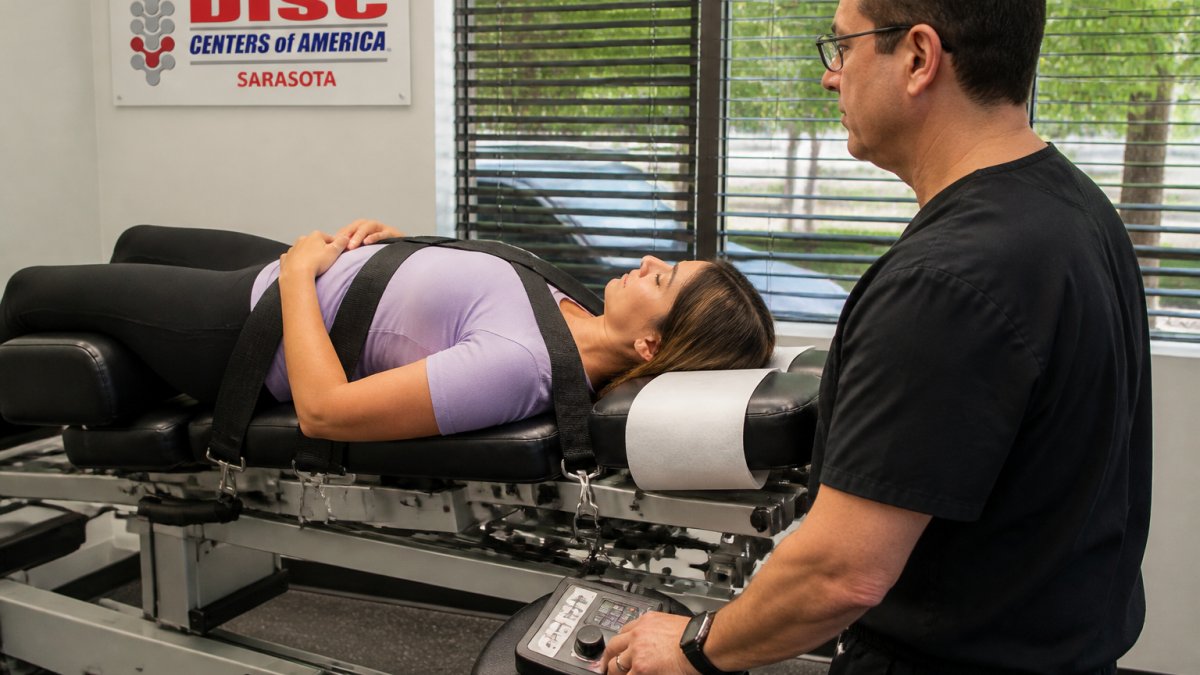
If you are weighing these options, a consultation can help you sort through them. Sarasota Disc Center offers a free MRI review and consultation, where a clinician can look at your imaging and talk through your options. book a free MRI review to get started, or see how decompression compares with traction before you decide. Our team is glad to answer your questions and help you choose a path that suits your goals.
Frequently Asked Questions
Is physical therapy or a chiropractor better for a herniated disc?
Neither option is better for every patient. Physical therapy focuses on exercise, strength and mobility over a longer rehabilitation period, while chiropractic care centers on manual adjustments and spinal manipulation, often aimed at short-term symptom relief. Many people with a herniated disc benefit from a clinical evaluation first, then a plan that fits their symptoms, imaging findings and goals. A qualified clinician can help you decide which approach, or combination, makes sense for your situation.
Can a chiropractor make a herniated disc worse?
Some manual techniques may not be appropriate for every disc injury, and the risk depends on the specific diagnosis, the technique used and the clinician's training. Patients should share their imaging results and tell their provider about any progressive weakness, numbness or loss of bladder or bowel control. Those warning signs call for urgent medical evaluation rather than further manual treatment. Ask any provider how they assess disc injuries before starting care.
What physical therapy exercises help a herniated disc?
Physical therapy plans for a herniated disc often include core strengthening, gentle mobility work, and movement retraining to reduce strain on the lower back or neck. Exercises are usually progressed gradually as pain and irritability allow. Specific exercises depend on where the disc is affected and how the nerves are involved. A licensed physical therapist can design a program that matches your symptoms and recovery goals.
Is non-surgical treatment for a herniated disc effective?
Many herniated discs improve with conservative care, which can include clinical evaluation, modified activity, therapeutic exercise, manual therapy, and medication recommended by a physician. Outcomes vary widely, so there is no guaranteed result. Sarasota Disc Center offers a free MRI review and consultation to help you understand your imaging and options. Persistent or worsening symptoms should prompt a follow-up with your medical provider.