 blog
blog
Chiropractic vs Spinal Decompression Therapy
Table of Contents
- Chiropractic vs Spinal Decompression Therapy: Core Differences
- How Chiropractic Adjustments Work
- How Spinal Decompression Therapy Works
- Chiropractic Adjustment for Herniated Discs
- Spinal Decompression Therapy Duration and Treatment Timeline
- Is Spinal Decompression Covered by Insurance
- Which Treatment Is Right for You
- Frequently Asked Questions
Last Updated: September 25, 2026
Chiropractic vs Spinal Decompression Therapy: Core Differences
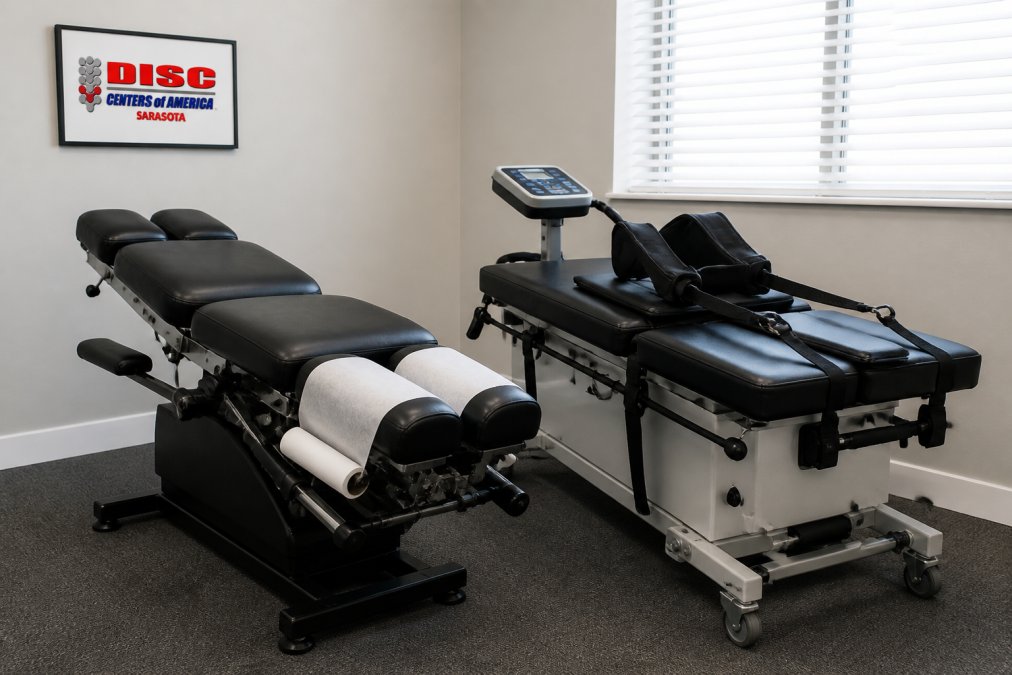
Patients with chronic back or neck pain often choose between chiropractic adjustments and spinal decompression therapy. Both are non-surgical, but they work differently. Understanding how chiropractic vs spinal decompression therapy differ helps you choose the right treatment.
Chiropractic adjustments realign the spine through manual manipulation; spinal decompression uses mechanical traction to create negative pressure inside the disc. One addresses joint position, the other targets the disc itself.
Chiropractic care treats vertebral segments through hands-on force; decompression uses computerized force control to decompress intervertebral discs. Choosing the wrong approach wastes months before finding relief.
How Chiropractic Adjustments Work
A chiropractic adjustment applies controlled force to restore vertebral alignment through quick, precise movements. The audible crack, called joint cavitation, is gas bubbles releasing inside the joint.
Chiropractic adjustments work best for:
- Restricted spinal mobility
- Vertebral subluxation (misalignment)
- Acute muscle tension
- General spinal maintenance
When a vertebra moves out of place, it pinches soft tissue and nerves. Realigning it relieves pressure and stimulates synovial fluid production, which lubricates the joint.
However, adjustments don't address disc problems. If a herniated disc presses on a nerve, realigning the vertebra won't change the disc position, many patients receive months of adjustments without improvement because the real problem is inside the disc.
Chiropractic care typically involves 2-3 visits per week initially, tapering to maintenance. This works for chronic stiffness but may not solve acute nerve compression.
How Spinal Decompression Therapy Works
Spinal decompression uses a specialized table to apply controlled mechanical traction, creating negative intradiscal pressure that pulls disc material back toward its center, away from the nerve root.
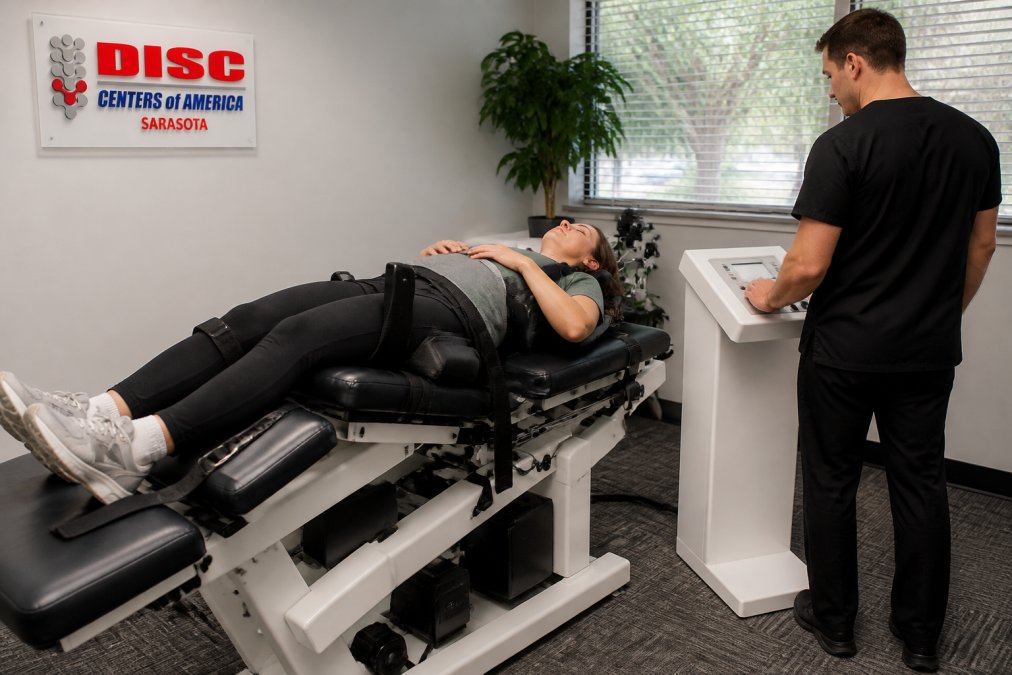
The process works on biomechanics. When the spine is under tension, discs compress. When tension releases, discs expand. A decompression table reverses compression systematically.
How it treats different conditions:
- Herniated discs: Pulls the nucleus pulposus back into the annulus, relieving nerve impingement
- Degenerative disc disease: Reduces pressure on damaged discs and promotes healing
- Sciatica: Decompresses the nerve root causing radiating leg pain
- Lumbar radiculopathy: Relieves nerve compression in the lower spine
The table uses computerized force control that adjusts automatically based on muscle resistance, preventing the protective muscle spasm that stops manual traction from working.
Treatment typically involves multiple sessions over several weeks. Many patients see improvement within the first few sessions.
Safety Screening and Contraindications
Not every patient is a candidate for spinal decompression. Thorough screening identifies contraindications that could make therapy unsafe or ineffective.
Absolute contraindications (do not use decompression):
- Spinal fusion hardware or metal implants: Titanium rods, screws, or cages can shift under traction forces and require imaging review before decompression.
- Severe osteoporosis: Weakened bone density increases fracture risk. Bone density screening may be required for patients over 65 or with known bone loss (the CDC).
- Active infection or malignancy: Spinal infections or cancer require medical management before any mechanical therapy.
- Pregnancy: Mechanical traction is contraindicated during pregnancy due to abdominal pressure and unknown fetal effects.
- Unstable fractures: Recent or healing fractures of the spine cannot tolerate traction forces.
- Severe spondylolisthesis: Vertebral slippage beyond Grade 2 may worsen under decompression.
Relative contraindications (require physician clearance):
- Aortic aneurysm: Abdominal aortic aneurysm requires clearance from the treating cardiologist before decompression.
- Severe osteoarthritis with instability: Advanced joint degeneration may not tolerate the movement.
- Recent epidural steroid injection: Spacing decompression 2-3 weeks after injection allows the medication to stabilize.
- Pacemakers or implanted cardiac devices: Electromagnetic interference is unlikely with modern tables, but cardiology clearance is prudent.
- Severe claustrophobia: Some patients cannot tolerate the positioning or enclosed sensation of the table.
Pre-treatment screening protocol:
Chiropractic Adjustment for Herniated Discs
Many people turn to chiropractic care first for herniated disc pain, but results vary widely.
Spinal Decompression Therapy Duration and Treatment Timeline
Treatment duration depends on your condition severity and how your body responds. Most protocols follow a structured schedule.
Typical timeline:
- Weeks 1-2: Initial phase, 5 sessions per week. Your body adapts to the therapy. Pain may decrease slightly but improvement accelerates after week 2.
- Weeks 3-4: Maintenance phase, 3 sessions per week. Disc material continues to resorb. Nerve inflammation decreases. Most patients report noticeable improvement by week 4.
- Weeks 5-6: Final phase, 2-3 sessions per week. Consolidation of gains. Disc healing continues. Pain relief becomes more stable.
Is Spinal Decompression Covered by Insurance
Insurance coverage for spinal decompression varies significantly; many plans don't cover it, some do under specific conditions.
Factors affecting coverage:
- Your specific plan: Some plans explicitly exclude decompression. Others include it under physical medicine benefits.
- Diagnosis: Insurance is more likely to cover decompression for documented herniated discs or radiculopathy than for general back pain.
- Prior treatment: Many plans require documentation of failed conservative care (physical therapy, chiropractic, medication) before approving decompression.
- Provider network: In-network providers may have better coverage than out-of-network facilities.
Steps to check your coverage:
- Call your insurance company and ask if spinal decompression is covered
- Ask whether your diagnosis qualifies
- Ask about prior authorization requirements
- Request out-of-pocket cost information
Cost-Effectiveness and Out-of-Pocket Analysis
Understanding the financial picture helps you evaluate whether decompression is worth the investment compared to other treatments.
Typical out-of-pocket costs:
For comparison:
- Chiropractic care: $50-$150 per visit, typically 2-3 visits per week = $400-$1,800 per month for ongoing care
- Physical therapy: $100-$200 per session, 2-3 times per week = $800-$2,400 per month
- Epidural steroid injections: $500-$2,000 per injection, often 1-3 injections over several months
- Spinal surgery: $50,000-$150,000+ depending on procedure complexity and facility
Success rate context:
- Herniated disc with radiculopathy: 60-80% of patients report significant improvement (reduction in pain and nerve symptoms) after a full protocol
- Degenerative disc disease: 50-70% report meaningful relief
- Failed conservative care: Patients who have not improved with physical therapy or chiropractic care for 6+ weeks show higher success rates (70-85%) with decompression than those with shorter symptom duration
Insurance billing codes:
When decompression is covered, it is typically billed under:
- CPT 97012: Mechanical traction, any body site; static or dynamic (per 15 minutes)
- CPT 97161-97163: Physical therapy evaluation codes (depending on complexity)
- ICD-10 diagnosis codes: M51.2x (cervical disc displacement), M51.3x (lumbar disc displacement), M54.4x (radiculopathy), etc.
Maximizing insurance coverage:
- Document prior conservative care: Keep records of physical therapy, chiropractic visits, and medication trials.
- Obtain prior authorization: Submit imaging and medical records upfront to prevent denials.
- Use in-network providers: Out-of-network providers often result in higher costs.
- Understand your deductible and co-insurance: Know your out-of-pocket responsibility.
Which Treatment Is Right for You
Choosing between chiropractic adjustments and spinal decompression depends on your specific situation; they address different problems.
Choose chiropractic adjustment if:
- Your primary issue is restricted spinal mobility
- You have muscle tension and joint stiffness
- Your pain is mild to moderate and not radiating down your leg
- You've had good results with adjustments in the past
- You prefer frequent short sessions over a structured protocol
Choose spinal decompression if:
- You have a confirmed herniated or bulging disc
- Your pain radiates into your leg (sciatica or radiculopathy)
- Physical therapy and chiropractic care haven't resolved your pain
- You want to address the underlying disc problem, not just manage symptoms
- You're trying to avoid surgery
| Factor | Chiropractic Adjustment | Spinal Decompression |
|---|---|---|
| Target | Joint alignment, vertebral position | Disc herniation, nerve compression |
| Best for | Mobility, stiffness, misalignment | Herniated discs, sciatica, radiculopathy |
| Visit frequency | 2-3 per week initially | Multiple sessions per week for several weeks |
| Time per session | 15-20 minutes | 30 minutes |
| Typical duration | Ongoing maintenance | Multiple sessions total |
| Works best when | Vertebrae are misaligned | Disc is herniated and pressing on nerve |
Frequently Asked Questions
What's the main difference between chiropractic adjustments and spinal decompression therapy?
Chiropractic adjustments use manual manipulation to realign vertebrae and restore spinal mobility through joint cavitation and soft tissue mobilization. Spinal decompression therapy uses computerized mechanical traction to create negative intradiscal pressure, gently stretching the spine to relieve nerve impingement and reduce disc herniation. Adjustments address spinal alignment immediately, while decompression works over multiple sessions to decompress affected intervertebral discs and promote healing.
How long does spinal decompression therapy duration typically last, and how often do patients need treatment?
Spinal decompression therapy typically involves multiple sessions over several weeks. The exact spinal decompression therapy duration depends on the severity of nerve impingement, the specific condition being treated, and individual healing response. Some patients experience relief within the first few weeks, while others require the full treatment course. Post-treatment recovery is usually rapid, with most patients returning to normal activities immediately after each session.
Is spinal decompression covered by insurance, and what are typical out-of-pocket costs?
Is spinal decompression covered by insurance varies by plan and carrier. Some insurance policies cover spinal decompression therapy when deemed medically necessary for conditions like lumbar radiculopathy or spinal disc herniation, while others classify it as experimental or elective. Coverage often requires prior authorization and documentation of failed conservative treatments. For pricing and specific insurance coverage details, contact your provider directly or request a consultation to discuss your plan's benefits.
Can chiropractic adjustments help with a herniated disc, or is spinal decompression better?
Chiropractic adjustment for herniated discs can provide pain relief and improved mobility by reducing nerve irritation through spinal alignment and joint mobilization. However, chiropractic adjustment for herniated discs works best for mild to moderate cases and may not address severe disc herniation or significant nerve impingement. Spinal decompression therapy is specifically designed to reduce intradiscal pressure and promote disc healing, making it more targeted for herniated discs. Many patients benefit from combined treatment protocols using both modalities, with chiropractic care supporting spinal stabilization between decompression sessions.