 blog
blog
Chiropractic Adjustment vs Spinal Decompression
Table of Contents
- Understanding Chiropractic Adjustments and Spinal Decompression
- How Chiropractic Adjustments Work
- How Spinal Decompression Therapy Works
- Key Differences: Chiropractic Adjustment vs Spinal Decompression
- How Long Does Spinal Decompression Take
- Is Spinal Decompression Covered by Insurance
- Non-Surgical Spinal Decompression Benefits and When to Choose Each Treatment
- Frequently Asked Questions
Last Updated: September 23, 2026
Understanding Chiropractic Adjustments and Spinal Decompression
Chronic back and neck pain often leads to two treatments: chiropractic adjustment vs spinal decompression therapy. Both promise relief, but they work in completely different ways, and choosing between them matters. (Source: the National Institute of Neurological Disorders and Stroke (NINDS))
A chiropractic adjustment uses controlled force to restore joint mobility and spinal alignment. Spinal decompression therapy uses traction to reduce pressure on discs and nerves. Understanding how each works will help you decide which makes sense for your situation.
How Chiropractic Adjustments Work
A chiropractic adjustment targets joint dysfunction directly by applying controlled force to a misaligned or restricted vertebra or joint, restoring normal mobility and alignment.
During an adjustment, the vertebra moves into proper position, joint mobility increases immediately, nerve pressure may decrease if misalignment was the cause, and muscle tension often releases.
Adjustments work best for joint dysfunction. If your pain comes from a pinched nerve caused by vertebral misalignment, an adjustment can provide rapid relief, often within one or two sessions.
Adjustments address joint mechanics, not disc damage. If a herniated disc is pressing on a nerve, moving the vertebra won't resolve the disc problem.
How Spinal Decompression Therapy Works
Spinal decompression therapy uses controlled traction to stretch the spine and reduce pressure inside the discs, rather than moving bones.
The equipment gently pulls the spine apart, creating negative pressure inside the discs that can pull herniated material back toward center, reduce nerve compression, improve blood flow, and allow healing.
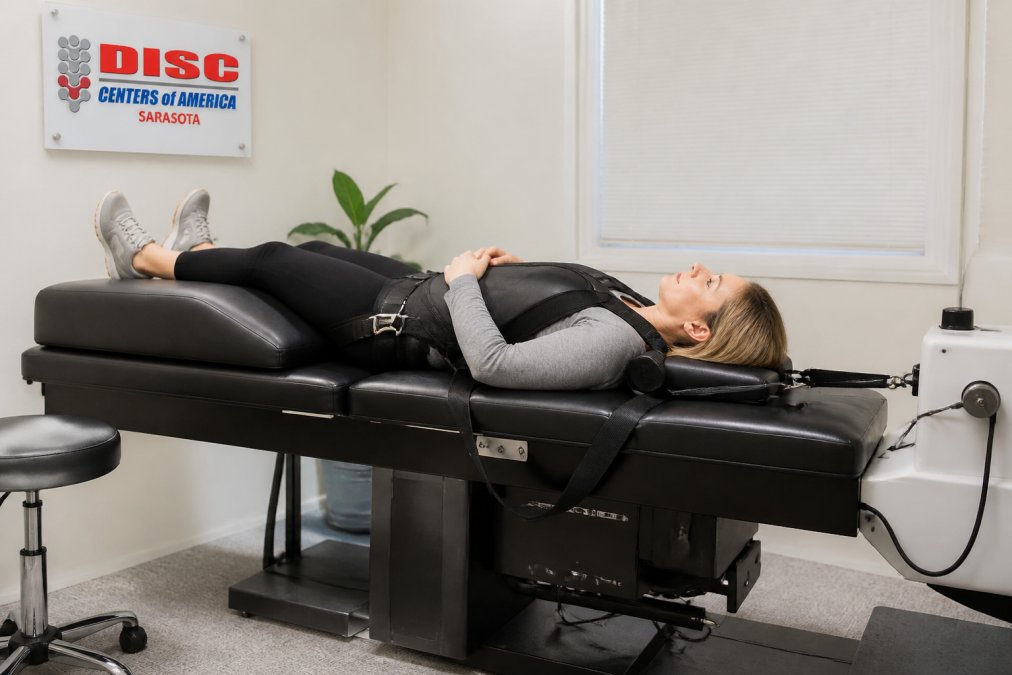
The treatment is passive, the machine does the work. Sessions typically last 20 to 30 minutes, and you remain fully clothed.
Decompression works best for disc problems: herniated discs, bulging discs, and nerve impingement from disc material. It addresses the source of pressure rather than joint mechanics.
Decompression requires multiple sessions over weeks to show results. Patients often report significant improvement after 12 to 20 sessions.
Key Differences: Chiropractic Adjustment vs Spinal Decompression
These two treatments target different problems and work through opposite mechanisms.
| Factor | Chiropractic Adjustment | Spinal Decompression |
|---|---|---|
| Mechanism | Controlled force to move vertebra | Gentle traction to stretch spine |
| What it targets | Joint misalignment and mobility | Disc pressure and nerve compression |
| Best for | Vertebral subluxation, joint dysfunction | Herniated discs, bulging discs, radiculopathy |
| Session length | 10-20 minutes | 20-30 minutes |
| Immediate relief | Often within 1-2 sessions | Gradual over multiple sessions |
| Long-term results | Maintenance care may be needed | Often resolves the underlying issue |
| Active or passive | Active manipulation | Passive treatment |
How Long Does Spinal Decompression Take
The timeline depends on what's causing your pain and how long you've had it.
Timeline by condition:
What happens week by week:
Factors that extend or shorten your timeline:
Severity of disc damage affects progress. A contained bulge responds faster than an extruded or sequestered disc fragment. Your initial imaging (MRI or CT scan) should clarify which category you're in.
Understanding your specific timeline requires an accurate diagnosis and honest assessment of your condition's severity. A consultation should include review of your imaging and a realistic estimate based on your particular situation, not a generic range.
Is Spinal Decompression Covered by Insurance
Insurance coverage for spinal decompression varies widely, but understanding the coverage landscape also requires knowing when insurance companies, and clinicians, should decline to offer the treatment at all.
Coverage factors that determine reimbursement:
Your specific insurance plan is the first determinant. Some plans classify decompression as an established, evidence-based treatment for disc-related conditions. Others classify it as experimental or investigational and deny coverage entirely. Medicare generally covers spinal decompression for specific diagnoses, though coverage varies by regional Medicare Administrative Contractor. Many commercial plans follow Medicare's lead, while others maintain stricter restrictions.
Your diagnosis matters significantly. Insurance is most likely to cover decompression for herniated discs with documented nerve compression, bulging discs causing radiculopathy, or spinal stenosis with leg pain. Coverage is less likely, or denied outright, for general back pain without imaging evidence of disc pathology, facet joint arthritis without nerve involvement, or muscle strain.
Your provider's credentials influence coverage decisions. Treatment from a licensed provider is more likely to be covered than treatment from an unlicensed provider. Some plans may require that treatment be ordered or supervised by an MD or DO, even if a chiropractor administers it.
Prior authorization is standard. Most insurers require imaging (MRI or CT scan) showing disc pathology and documentation that conservative care (physical therapy, anti-inflammatory medication, rest) has been attempted for a minimum period, often 4 to 12 weeks, before approving decompression.
Before starting treatment, take these steps:
Contact your insurance company directly with your policy number and ask three specific questions: (1) Is spinal decompression covered under my plan? (2) What diagnosis codes qualify for coverage? (3) What documentation or prior authorization do I need? Write down the name, date, and reference number of anyone you speak with.
CALL TODAY TO SCHEDULE YOUR FREE CONSULTATION →
Request a written determination. Don't rely on a verbal answer. Ask your insurer to provide coverage determination in writing so you have documentation if a claim is later denied.
Work with your provider's billing department. Most clinics handle prior authorization requests and can submit imaging and medical records directly to your insurer. This speeds the process and reduces the chance of denial due to missing documentation.
What to do if your plan doesn't cover decompression:
Ask about self-pay options and payment plans. Many clinics offer discounted rates for uninsured patients or those whose insurance denies coverage. Costs vary by region and clinic. Many clinics offer discounted rates for uninsured patients or those whose insurance denies coverage.
Inquire about flexible payment plans. Some clinics offer 0% interest financing or monthly payment options that make treatment accessible without upfront payment.
Consider appealing a denial. If your insurer denies coverage, ask your provider to file an appeal with additional clinical documentation. Many appeals succeed, especially if you have imaging evidence of disc pathology and documented failed conservative care.
Critical safety screening: When decompression should NOT be covered or offered:
Beyond insurance coverage decisions, certain medical conditions make spinal decompression contraindicated, meaning it should not be performed, regardless of insurance approval. Understanding these exclusions protects you from inappropriate treatment.
Active infection or malignancy in the spine is an absolute contraindication. If you have spinal infection (discitis, osteomyelitis) or cancer involving the vertebrae, decompression can worsen the condition and should never be attempted. Imaging should rule this out before treatment begins.
Severe osteoporosis or bone density loss makes the spine too fragile for traction forces. Patients with diagnosed osteoporosis, particularly those on long-term corticosteroids, should not undergo decompression without physician clearance. Bone density testing (DEXA scan) may be warranted before treatment.
Recent spinal surgery (within 6 months) is typically a contraindication. The spine needs time to heal after surgical fusion, laminectomy, or discectomy. Decompression traction can disrupt healing and compromise surgical outcomes. Your surgeon should clear you before attempting decompression.
Cauda equina syndrome (sudden loss of bowel/bladder control, bilateral leg weakness, or severe bilateral leg pain) is a medical emergency requiring immediate surgery, not decompression. If you develop these symptoms, seek emergency care immediately.
Unstable spinal fracture or significant ligamentous injury requires immobilization or surgery, not decompression. Traction on an unstable spine can cause further injury.
Pregnancy is a relative contraindication. Most clinics defer treatment until after delivery to avoid any risk to the fetus.
Ask your provider directly: "Are there any medical reasons I should not have spinal decompression?" A responsible clinic will screen for these contraindications before treatment begins and will not proceed if safety concerns exist, regardless of insurance approval.
Non-Surgical Spinal Decompression Benefits and When to Choose Each Treatment
Both treatments offer real benefits. The question is which one matches your condition and your goals.
Choose chiropractic adjustment if:
- Your pain is related to joint misalignment or restricted mobility
- You want fast relief
- Your pain is localized to one area of the spine
- You've had success with chiropractic care in the past
Choose spinal decompression if:
- You have a diagnosed herniated or bulging disc
- You're experiencing radiating pain, numbness, or tingling (signs of nerve compression)
- Other treatments haven't worked
- You want to avoid surgery and injections
Consider combining both if:
- You have both joint dysfunction and disc problems
- One treatment alone hasn't resolved your pain
- You want to address multiple causes of your pain simultaneously
Many patients find that combining treatments can be beneficial. An adjustment restores joint mobility while decompression reduces disc pressure. Together, they can address both mechanical and structural problems causing pain.
The key is getting an accurate diagnosis first. You need to know whether your pain comes from a misaligned joint, a damaged disc, muscle tension, or some combination of these. That diagnosis should guide your treatment choice.
At Sarasota Disc Center, we specialize in spinal decompression for patients who've tried other approaches without lasting relief.
Frequently Asked Questions
Can spinal decompression therapy be used alongside chiropractic adjustments?
Yes, many patients benefit from combining both treatments as part of a comprehensive care plan. Chiropractic adjustments address joint mobility and spinal alignment, while spinal decompression targets disc bulges and nerve pressure. A qualified healthcare provider can determine if integrating both therapies suits your specific condition and treatment goals. Some patients find sequential use, starting with decompression to relieve acute disc pressure, then adding adjustments for maintenance, produces better outcomes than either treatment alone.
How long does spinal decompression take to show results?
Timelines for experiencing relief vary based on condition severity and individual healing capacity. Your healthcare provider will monitor progress and adjust the plan accordingly. Patience and adherence to the full treatment protocol significantly influence outcomes.
What conditions are best treated by spinal decompression versus chiropractic care?
Spinal decompression excels at treating herniated discs, disc bulges, nerve impingement, and radiculopathy by creating negative pressure within the spinal disc. Chiropractic adjustments work best for joint dysfunction, subluxation, and restricted range of motion by restoring proper segmental mechanics. Degenerative disc disease, sciatica, and neck pain may respond to either approach depending on the underlying cause. A thorough evaluation determines which treatment, or combination, addresses your specific spinal condition most effectively.
Is spinal decompression covered by insurance?
Insurance coverage for spinal decompression varies significantly by plan, provider, and medical necessity documentation. Some major insurers cover it when conservative treatments fail and imaging confirms disc pathology, while others classify it as experimental or elective. Contact your insurance provider with your diagnosis code and treatment recommendation to verify coverage. Many clinics offer payment plans or discuss out-of-pocket costs upfront if insurance denies coverage.