 How-to
7 Natural Ways to Relieve Nerve Pressure at Home
Quick Summary
Natural relief for nerve pressure starts with resting the area and avoiding the movements that trigger symptoms, then using ice early and heat later, fixing posture, and doing gentle stretches. Many mild cases improve within a few weeks, but symptoms that persist or include weakness need a professional evaluation.
- Change or pause activities that trigger symptoms, taking short breaks every 30 to 45 minutes.
- Use ice for 15 to 20 minutes during the first 48 to 72 hours after a flare-up.
- Switch to moderate heat after the first few days to relax tight muscles.
- Walking for 10 to 15 minutes is a good starting point for most people.
- See a doctor if weakness appears, symptoms persist beyond six weeks, or any red flag develops.
Table of Contents
- What Nerve Pressure Feels Like and Why It Happens
- Step 1: Rest the Affected Area and Change Your Activity
- Step 2: Use Ice and Heat to Calm Swelling and Tension
- Step 3: Fix Posture and Break Up Long Periods of Sitting
- Gentle Stretches for a Pinched Nerve to Try at Home
- Step 4: Relax, Massage, and Care for Your Feet
- How Long Does a Pinched Nerve Last and When to See a Doctor for a Pinched Nerve
- Your Next Step: Getting a Professional Evaluation of Your Nerve Pressure
- Frequently Asked Questions
What Nerve Pressure Feels Like and Why It Happens
Last Updated: October 30, 2026
Nerve pressure can make an ordinary day feel like a struggle. Many people who first notice these symptoms wonder whether they can handle things at home. (Source: the National Institute of Neurological Disorders and Stroke (NINDS))
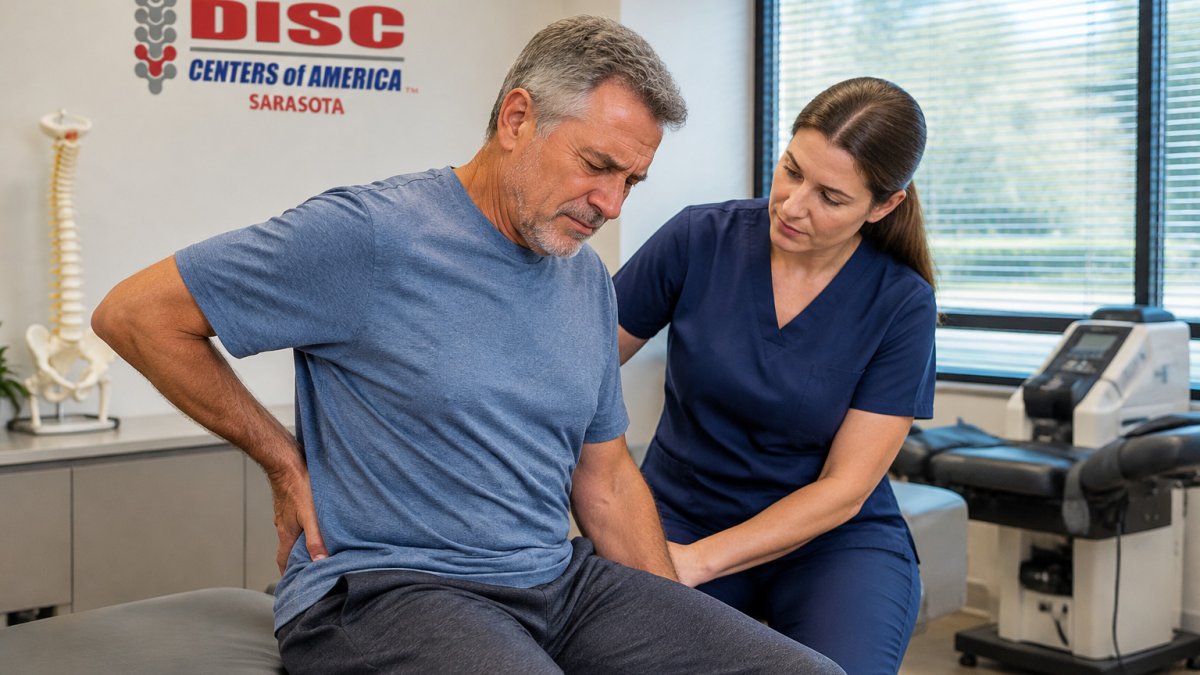
Nerve pressure usually happens when something presses on a nerve. A swollen disc, tight muscles, or narrowed space around the spine are common causes.
Here is what people commonly describe:
- Shooting or burning pain that travels along a path
- Numbness or tingling, often called "pins and needles"
- Weakness in a hand, arm, or leg
Nerve Compression vs. Peripheral Neuropathy: Why the Difference Matters
Most home-care advice online lumps "pinched nerve" and "neuropathy" together, but they are not the same problem, and the steps that help one may not help the other.
Nerve compression (a pinched nerve) is a mechanical problem: something is physically pressing on a nerve.
Peripheral neuropathy is a nerve-health problem, not a pressure problem. It usually affects the longest nerves first, so symptoms show up in both feet and sometimes both hands, often in a "stocking-and-glove" pattern.
A quick self-check can point you in the right direction:
- One side or both? Compression is usually one-sided and follows a nerve path. Neuropathy is usually symmetric and starts in the feet.
- Does position change it? If leaning back, turning your head, or sitting differently changes the pain, compression is more likely.
- What does it feel like? Sharp, shooting, or electric pain that travels favors compression. Steady burning or numbness in the feet favors neuropathy.
Why the Cause Changes Your Home-Care Plan
The steps in this article, rest, ice and heat, posture changes, stretching, and relaxation, are aimed mainly at mechanical nerve pressure. Targeted physical interventions remain essential when you need to manage sciatica pain effectively while you work toward resolving the root cause of your discomfort.
Home care can ease mild symptoms for many people. It is not a replacement for a proper exam, though. Keep reading for seven practical ways to relieve nerve pressure at home, along with the warning signs that mean you should get checked soon.
Step 1: Rest the Affected Area and Change Your Activity
Rest is often the first step. The goal is to stop repeating the movement that irritates the nerve, not to stop moving entirely.
Start by noticing which activities make your symptoms worse. Common triggers include:
- Lifting heavy objects
- Long periods of looking down at a phone
- Repetitive hand or wrist motions
Once you know your triggers, adjust them. Take short breaks every 30 to 45 minutes. Switch tasks often so the same muscles do not stay tight for hours.
Avoid complete bed rest for long periods. Gentle movement helps blood flow and keeps stiffness from building up.
Step 2: Use Ice and Heat to Calm Swelling and Tension
Ice and heat are simple tools. They work in different ways, so it helps to use each one for the right reason.
- Ice: Use cold for the first 48 to 72 hours after a flare-up. Cold can reduce swelling and numb sharp pain. Wrap an ice pack in a thin towel and apply it for 15 to 20 minutes at a time.
- Heat: Use warmth after the first few days to relax tight muscles. A warm towel or heating pad can loosen stiff tissue around the nerve. Keep the heat moderate and never fall asleep on a heating pad.
Some people alternate between cold and warm water in the shower. Many find this relaxing, but stop if it makes the pain worse.
The article suggests using cold early and heat later, as summarised below.
| Tool | When to use | How long |
|---|---|---|
| Ice | First 48 to 72 hours after a flare-up | 15 to 20 minutes at a time |
| Heat | After the first few days | Moderate heat, never while asleep |
Step 3: Fix Posture and Break Up Long Periods of Sitting
Posture plays a big role in nerve pressure, especially in the neck and lower back. Slouching or leaning forward for long stretches can narrow the space around the spine.
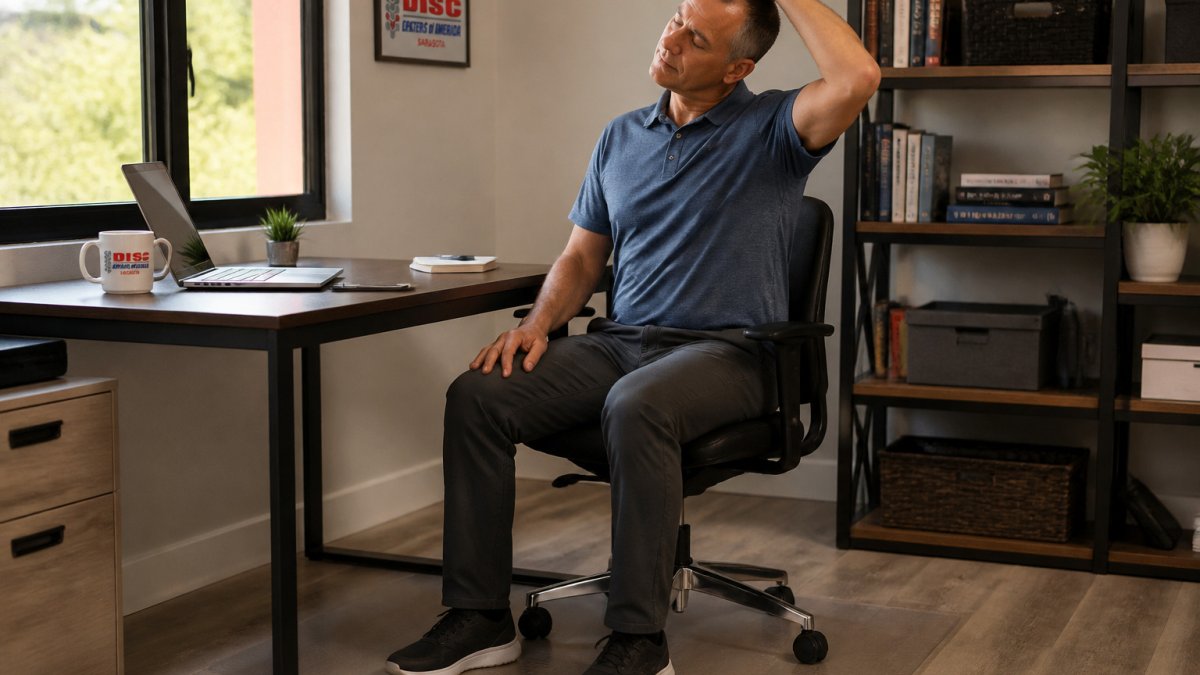
Try these simple changes:
- Keep your feet flat on the floor with knees at about hip height
- Put your computer screen at eye level
- Sit with your lower back supported by a chair or a small cushion
Sitting for long periods is hard on the spine. A common mistake is thinking one good chair solves the problem. Movement matters just as much as the chair itself.
Gentle Stretches for a Pinched Nerve to Try at Home
Stretching can help release tight muscles that press on a nerve. Move slowly and stop if you feel sharp pain or numbness that gets worse.
CALL TODAY TO SCHEDULE YOUR FREE CONSULTATION →
Try these gentle stretches:
- Chin tucks: Sit tall and gently pull your chin straight back, as if making a double chin. Hold for 5 seconds and repeat 5 times.
- Seated spinal twist: Sit with your feet flat, rotate your upper body slowly to one side, hold for 15 seconds, and switch sides.
- Hamstring stretch: Lie on your back, loop a towel around one foot, and gently straighten the leg until you feel a mild pull. Hold for 20 seconds.
- Cat-cow: On hands and knees, slowly arch and round your back for 8 to 10 cycles.
Yoga and gentle stretching classes can also help. Choose a beginner-friendly class and tell the instructor about your symptoms.
Step 4: Relax, Massage, and Care for Your Feet
Stress makes muscles tense, and tense muscles can increase pressure on nerves. Relaxation techniques can help break that cycle.
- Deep breathing: Breathe in slowly for four counts, then out for six. Repeat for two to three minutes.
- Progressive relaxation: Tense each muscle group for five seconds, then release. Start with your feet and work up to your shoulders.
- Mindfulness meditation: Even five minutes a day can reduce stress and help you notice tension early.
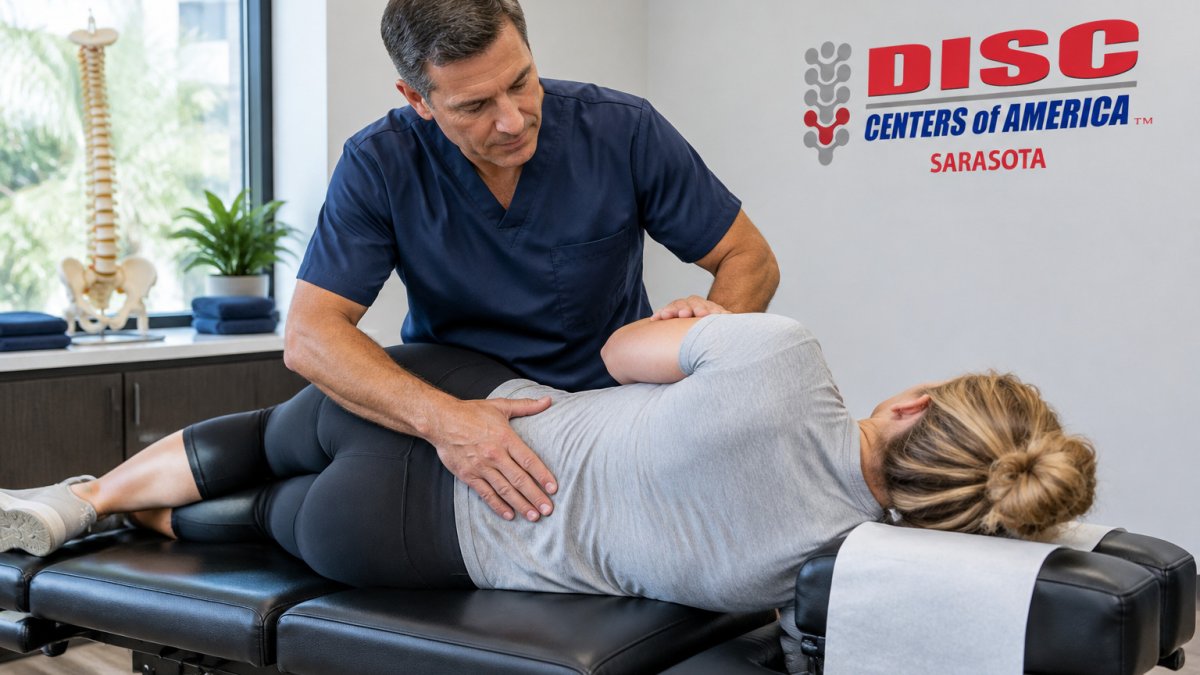
Massage can ease tight muscles around a nerve.
If you feel numbness or tingling in the feet, foot care matters. If numbness and tingling in your feet persist despite home care, explore peripheral neuropathy treatment options in Sarasota, FL.
Check with a pharmacist before using topical products, especially if you take other medications.
How Long Does a Pinched Nerve Last and When to See a Doctor for a Pinched Nerve
Many mild pinched nerves improve within a few weeks with rest and gentle care. A common pattern is gradual improvement over two to six weeks, with good days and bad days along the way. If your symptoms persist, you can learn about non-surgical pinched nerve pain treatment in Sarasota, FL. Recovery time depends on the cause, how severe the pressure is, and how quickly you start treatment.
A Simple Timeline for Judging Progress
Use this rough timeline to decide whether home care is working or whether you need help:
- Days 1-3: Expect soreness and irritation. Rest the area, use ice, and avoid the movements that trigger symptoms.
- Days 4-14: Switch to heat and gentle movement. Symptoms should trend toward less intense, less frequent, or less widespread.
- Weeks 2-6: Most mild cases resolve or clearly improve. If you are not improving, or if you are improving but plateaued, it is time for an evaluation.
A useful rule: track your symptoms in a simple daily note. If the trend line is flat or worsening over two weeks, stop guessing and get checked.
Red Flags: When to Get Care Right Away
Some symptoms mean you should not wait. Seek emergency care (call 911 or go to an emergency room) for any of the following:
- Loss of bladder or bowel control, or new trouble urinating
- Saddle numbness, numbness in the groin, inner thighs, or the area that would touch a saddle
- Sudden or severe weakness in an arm or leg, or a foot that drags
These signs may point to a serious condition, such as a large disc herniation pressing on the spinal cord or cauda equina, that needs urgent care. Do not drive yourself if you have sudden weakness or numbness.
Urgent (But Not Emergency) Reasons to Call Your Doctor
Schedule a prompt appointment, within a few days, if you notice:
- Weakness that is new or getting worse, even if it is mild
- Numbness that is spreading or becoming constant
- Symptoms in both arms or both legs
- Pain that wakes you from sleep or is not touched by over-the-counter relief
What to Bring to Your Appointment
A little preparation makes the visit far more useful:
- A written timeline of when symptoms started and what makes them better or worse
- A list of your medications, supplements, and doses
- Any recent imaging, even if it was for another problem
- Notes on which activities you have already tried and what happened
Home care works well for many people with mild symptoms, but it cannot fix every cause. If you have had symptoms for more than a few weeks, if weakness is part of the picture, or if any red flag appears, schedule an evaluation.
Your Next Step: Getting a Professional Evaluation of Your Nerve Pressure
Home care is a good first step, but it does not tell you what is causing the pressure.
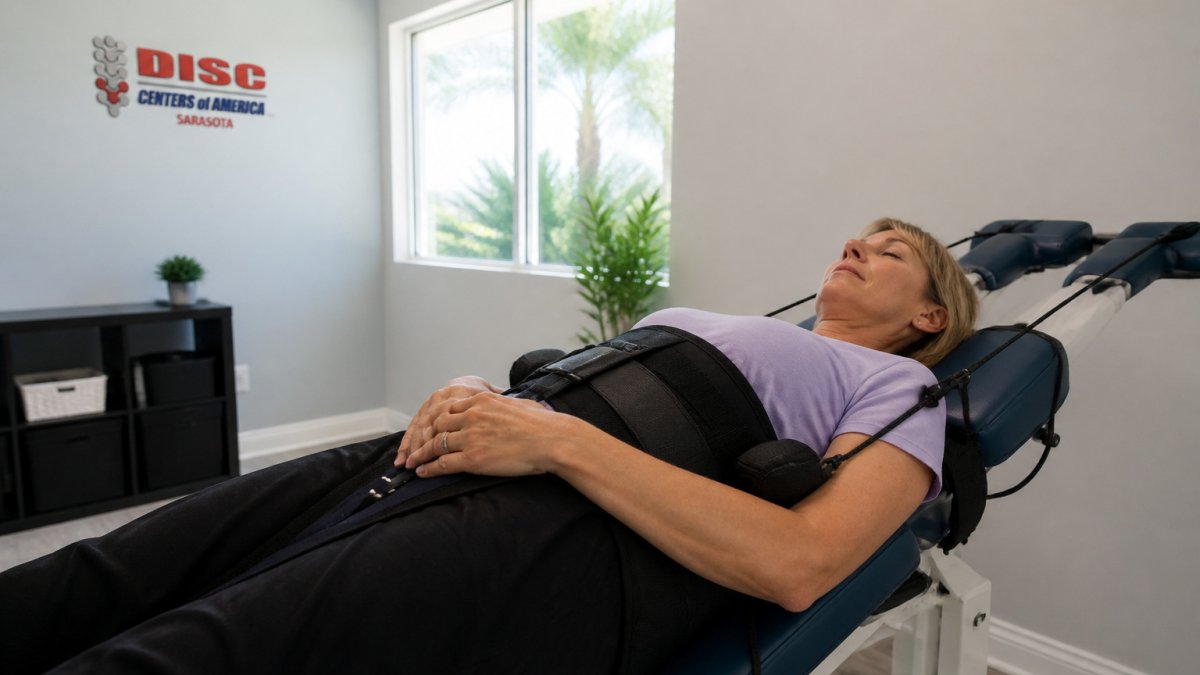
At Sarasota Disc Center, Dr. David Cifra, DC, offers non-surgical spinal decompression for patients dealing with nerve and disc pressure.
To schedule a consultation, call our office or visit our website. Bring any recent imaging and a list of the activities that trigger your symptoms.
Frequently Asked Questions
What natural remedies can help with nerve pain?
Rest, activity changes, alternating ice and heat, posture correction, and gentle stretching are the most common at-home approaches for nerve pain caused by pressure. Relaxation techniques such as deep breathing can also ease muscle tension around the affected area. These measures often help mild symptoms but do not fix the underlying cause. If pain, numbness, or weakness persists beyond a few weeks or worsens, schedule an evaluation with a qualified professional. Over-the-counter topical pain relievers may offer temporary comfort, but check with a pharmacist or doctor before combining them with other medications.
Can heat or ice help with a pinched nerve?
Ice can reduce swelling and numb sharp, shooting pain during the first few days of irritation. Heat relaxes tight muscles and can improve comfort once acute swelling has settled. Many people alternate the two in 15 to 20 minute sessions, with a cloth between the skin and the pack. Stop if the skin becomes red, numb, or blistered. Heat or ice is a symptom-management tool, not a fix for compression, so persistent symptoms still warrant a professional assessment.
How long does a pinched nerve take to improve?
Mild pinched nerve symptoms often improve within a few days to several weeks when the pressure is reduced through rest, posture changes, and gentle movement. Recovery time depends on the cause, how long the pressure has been present, and the person's overall health. Symptoms lasting longer than several weeks, or those that keep returning, should be evaluated rather than simply waited out, because prolonged compression can affect nerve function.
When should you see a doctor for nerve pain?
See a doctor promptly if you have sudden or severe weakness, numbness in the groin or inner thighs, loss of bladder or bowel control, or numbness that spreads quickly. These can signal an emergency that needs immediate care. Seek a non-urgent evaluation if pain, tingling, or numbness lasts more than a few weeks, interferes with sleep or work, or does not respond to home care. Only a qualified professional can determine the cause of your symptoms.