 How-to
How to Manage Sciatica at Work: 7 Practical Steps
Last Updated: November 17, 2026
Quick Summary
Managing sciatica at work starts with changing position often instead of sitting still for hours. Stand, shift your weight, or walk for a few minutes every half hour, and set reminders so you do not rely on memory. Pair these breaks with a desk setup that supports your lower back.
- Stand, roll your shoulders, and take 3 to 5 slow steps every 30 minutes.
- Walk for 2 to 5 minutes every hour, such as to a water fountain.
- Set chair height so knees sit at roughly 90 degrees with feet supported.
- Place the top of the monitor at or just below eye level, about an arm's length away.
- Stop any exercise that sends pain down the leg or causes numbness.
Table of Contents
- Why Sitting Aggravates Sciatica and What to Change First
- Building a Workday Schedule for Movement and Position Changes
- Setting Up an Ergonomic Desk for Sciatica Relief
- Desk-Friendly Sciatica Exercises and Stretches to Try
- Lifting, Driving and Other Tasks That Flare Symptoms
- How Much Time Off Work Sciatica Typically Requires
- When to See a Doctor About Work-Related Sciatica
- Frequently Asked Questions
Sciatica can turn a regular workday into a test of endurance. Sitting for hours, lifting boxes, or driving to a job site can make the sharp, shooting pain down the leg worse, and many people dealing with sciatica at work feel stuck between pushing through and stepping away. Sarasota Disc Center provides non-surgical care for nerve and disc pain, and the steps below are practical changes you can start on your own. Readers weighing non-surgical options can also compare spinal decompression with physical therapy as a longer-term complement to these changes. They will not replace a medical evaluation, but they can reduce flare-ups while you work.
Why Sitting Aggravates Sciatica and What to Change First
Sitting puts more pressure on the lower spine than standing does, especially when the hips are bent and the back is slumped (ncbi.nlm.nih.gov). That pressure can irritate the sciatic nerve, the large nerve that runs from the low back through the buttock and down each leg.
Start with the simplest change: stop sitting in one position for long stretches. Stand up, shift your weight, or walk for a minute every half hour. Small, frequent changes do more good than one long break.
A common mistake is assuming that a better chair alone will fix the problem. Chairs help, but movement matters more.
Building a Workday Schedule for Movement and Position Changes
A written schedule makes it easier to move before pain builds, because sciatica at work tends to worsen with long, unbroken stretches in one position. The plan below is a starting point; adjust the intervals to your tolerance and your job. Small, frequent changes are generally more helpful than one long break.
A sample desk-workday plan:
- Every 30 minutes: Stand, roll your shoulders, and take 3 to 5 slow steps. This is a posture reset, not a workout.
- Every hour: Walk for 2 to 5 minutes, such as to a water fountain or down a hallway. Walking is low-impact and keeps the nerve and surrounding muscles moving.
- Mid-morning: Do one set of gentle low-back and leg stretches, such as the seated nerve glide or standing hamstring stretch described below.
- Before lunch: Take a slightly longer walk, even 10 minutes, and reset your chair and screen when you return.
- Mid-afternoon: Check your posture and repeat one set of stretches.
- Late afternoon: Do a final posture reset and plan the next day's breaks.
Set a phone or computer reminder so you do not rely on memory. If you work in a job that involves standing, do the opposite: sit or lean for short breaks and shift your weight from one leg to the other. If you drive for a living, stop every hour or two to walk and stretch, and use a lumbar cushion in the seat.
Adapting the plan to your job type:
- Office and hybrid work: Alternate sitting and standing in blocks, and use the hourly walk as a hard stop. Standing desks are most useful when you actually change position, since standing still for hours can be as uncomfortable as sitting.
- Driving: Build in scheduled stops rather than waiting for pain. A 5-minute walk at each stop does more than shifting in the seat.
- Standing and retail work: Use a low step or stool to rest one foot, and take seated breaks when possible. Some people find supportive footwear helpful for fatigue, though footwear does not treat the nerve itself.
- Manual and lifting work: Break up repetitive lifting with lighter tasks, and ask about temporary task changes if pain is flaring.
Building tolerance: Start with the 30-minute reset and the hourly walk, and add the stretch blocks once those feel manageable. If a day goes badly, do not abandon the schedule; return to the shorter intervals the next day. A common pattern is that people do well for a few days, then skip breaks when work gets busy, and the pain returns.
Watch out: If movement consistently sends sharp pain down the leg or causes numbness, stop and seek an evaluation rather than pushing through the schedule.
The article lays out a sample desk-workday plan with set intervals for movement and stretching:
| Interval | Action | Time or frequency |
|---|---|---|
| Every 30 minutes | Stand, roll shoulders, take 3 to 5 slow steps | Posture reset |
| Every hour | Walk to a water fountain or down a hallway | 2 to 5 minutes |
| Mid-morning | One set of gentle low-back and leg stretches | One set |
| Before lunch | Longer walk, then reset chair and screen | 10 minutes |
| Mid-afternoon | Check posture and repeat one set of stretches | One set |
| Late afternoon | Final posture reset and plan next day's breaks | End of day |
Setting Up an Ergonomic Desk for Sciatica Relief
A desk setup that fits your body reduces the load on the lower back and takes pressure off the sciatic nerve. The order of adjustments often matters as much as the settings themselves, because changing one element shifts the others.
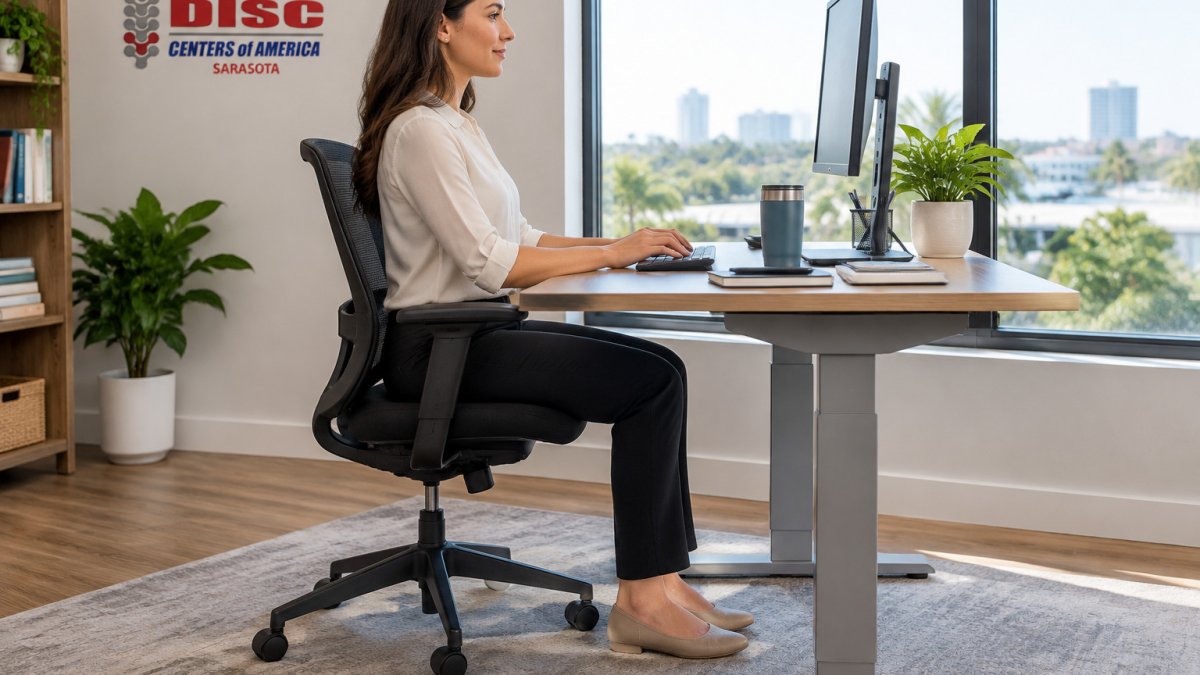
Step 1: Set chair height first. Sit with your feet flat on the floor. Raise or lower the seat until your knees are at roughly 90 degrees and your hips are level with or slightly higher than your knees.
Step 2: Support the lower back. Adjust the lumbar support so it fills the curve of your lower back, roughly at belt height. A rolled towel or small lumbar cushion works if the chair has no adjustment.
Step 3: Position the monitor. Place the top of the screen at or just below eye level, about an arm's length away. Keeping the screen at eye level helps limit the slumped posture that can aggravate sciatica, and sciatica FAQs can clarify how posture-related symptoms fit into the bigger picture.
Step 4: Set the keyboard and mouse. Keep your elbows near your sides at about 90 degrees and your wrists relaxed and straight. The keyboard should be close enough that you are not reaching forward, which pulls the shoulders and upper back out of alignment.
Step 5: Add a standing option. A standing desk or a riser that lifts your screen lets you alternate between sitting and standing.
Step 6: Check the floor and reach. Keep both feet supported, and place frequently used items within easy reach so you are not twisting or leaning repeatedly. A headset reduces the neck strain of cradling a phone.
Watch out: If a new setting increases leg pain, numbness, or tingling, return to the previous position and adjust one element at a time rather than changing everything at once.
For non-desk jobs: The same principles apply with different equipment. Drivers can raise the seat so the hips are level with the knees, add a lumbar cushion, and move the seat forward enough to avoid reaching for the pedals.
Desk-Friendly Sciatica Exercises and Stretches to Try
Stop any exercise that sends pain down the leg or causes numbness.
Seated nerve glide: Sit tall in your chair. Extend one leg straight, keeping the heel on the floor. Gently point and flex your foot 10 times, then switch legs.
Seated spinal flexion: Sit with your feet flat. Slowly lean forward and let your back round slightly, then sit up straight. Repeat 5 to 8 times.
Standing hamstring stretch: Place one heel on a low step or chair. Keep the leg straight and lean forward gently from the hips until you feel a light stretch. Hold for 20 to 30 seconds.
Standing lower back extension: Stand and place your hands on your lower back. Lean back gently, then return to standing. Repeat 5 times, and stop if the pain moves down the leg.
Core support: Sit tall and gently tighten your belly muscles as if bracing for a light tap. Hold for 5 seconds and relax. Repeat 10 times.
Do these movements a few times a day, not all at once. If you have any doubt about which exercises suit your condition, ask a qualified health professional before you start.
Lifting, Driving and Other Tasks That Flare Symptoms
Some work tasks commonly make sciatica worse:
- Lifting: Bend at the hips and knees, keep the load close to your body, and avoid twisting while lifting.
- Driving: Use a small lumbar cushion, and stop every hour or two to walk.
- Prolonged standing: Shift your weight, rest one foot on a low step, and sit when possible.
- Carrying heavy bags: Use a backpack or split the load between both hands.
Watch out: pushing through sharp pain while lifting can strain an already irritated nerve. Ask a coworker for help or use a cart instead.
How Much Time Off Work Sciatica Typically Requires
Time away from work varies widely. Many people with mild sciatica keep working with changes to their routine, while others with severe symptoms need short periods of rest or modified duties. Your doctor can help you decide what is reasonable for your job.
If your work involves heavy lifting, long driving, or physical labor, ask your employer about temporary changes such as lighter duties or more breaks. Some workplaces offer leave options under federal or state rules. The U.S. Department of Labor explains the basics of the Family and Medical Leave Act on its official website (Family and Medical Leave (FMLA)). Your human resources team can tell you what applies to your situation.
When to See a Doctor About Work-Related Sciatica
Schedule an evaluation if your leg pain lasts more than a few weeks, keeps returning, or stops you from doing your job. Seek care sooner if you notice any of these warning signs:
- Numbness or weakness in one or both legs
- Trouble controlling your bladder or bowels
- Numbness in the groin or inner thigh area
- Pain that is severe, sudden, or getting worse quickly
These symptoms need urgent medical attention.
Many people with sciatica want to avoid surgery. At Sarasota Disc Center, we provide non-surgical spinal decompression for patients with herniated discs, nerve pain, and sciatica. Dr. David Cifra provides personalized care. Call us for a FREE MRI Review and Consultation to learn whether conservative care may fit your needs.
Frequently Asked Questions
How am I supposed to work with sciatica?
Most people with sciatica can keep working, but the job may need adjusting. Change position every 30 to 60 minutes, avoid long stretches of sitting or standing still, and keep heavy lifting to a minimum while symptoms are active. Ask your employer about temporary changes such as a sit-stand desk, more frequent breaks or lighter duties. If pain worsens, numbness spreads or weakness develops, stop and contact a qualified clinician rather than pushing through the shift.
Should you be off work with sciatica?
Time off depends on how severe your symptoms are and what your job requires. Mild sciatica often allows continued work with modifications, while severe pain, leg weakness or jobs with heavy physical demands may call for a short leave. Discuss your situation with a healthcare provider, who can advise on whether rest or work restrictions are appropriate. In the United States, your employer may have options under leave or accommodation policies, so check your company's human resources guidance.
What is the best way to sit at work with sciatica?
Sit with your hips slightly higher than your knees, your feet flat on the floor, and your lower back supported by a chair with lumbar support. Keep the monitor at eye level and your elbows close to your body. Avoid crossing your legs and sitting on a wallet or thick object in your back pocket. Shift position regularly, since no single posture suits every person with sciatica for long periods.
Which stretches or exercises may help sciatica during the workday?
Gentle movements such as seated knee-to-chest stretches, standing lower back extensions and short walks can ease stiffness during the day. Seated nerve glides, where you slowly straighten and bend the knee while gently moving the head, may also help some people. Perform each movement slowly, stop if symptoms become sharper or travel further down the leg, and check with a qualified professional before starting a new routine.